
Peptides: Concerns and Challenges with Dr. Michael Albert
What if something being talked about as “cutting-edge” in health spaces… isn’t actually well understood yet?
I’m excited to talk about a topic that keeps coming up everywhere right now — peptides.
They’re being discussed in clinics, online forums, and social media feeds, often with a mix of confidence and confusion. The problem is, the conversation has gotten so loud that it’s hard to separate what’s actually known from what’s just being repeated. So instead of trying to cover this alone, I wanted to bring in someone who can help ground it in real clinical experience and science.
Joining the conversation is Dr. Michael Albert. He’s a board-certified internal medicine physician and a diplomate of the American Board of Obesity Medicine. He trained at Cedars-Sinai Medical Center in Los Angeles, where he served as a Kenmar Fellow and faculty member, and he went on to found the medical weight management program at the Weight Loss Center.
He currently serves as a clinical assistant professor of medicine at the University of Oklahoma Health Sciences Center and is the co-founder and chief medical officer of Accomplish Health, a nationwide telehealth practice focused on comprehensive obesity medicine and medical bariatrics. His work is centered on translating medical evidence into practical, patient-centered care and improving how conversations around obesity are handled in clinical settings.
Beyond his clinical work, Dr. Albert is also widely known for his educational content online, where he shares clear, science-based explanations to an audience of more than 300,000 people across platforms.
So with that context in place, we’re going to break down peptides — what they actually are, what the science says, and where the gaps still are.
If this is something you’ve been hearing about but never really understood, keep reading — it gets clearer once you break it down properly.
What Is a Peptide, Really?
If you've been seeing the word "peptide" everywhere lately — in wellness content, biohacking forums, or your favorite health influencer's feed — you're not imagining it. It's having a serious moment. But like a lot of buzzy health terms, it gets thrown around without much explanation, so let's actually break it down. At its most basic, a peptide is like a micro-protein: a chain of amino acids typically between 2 and 50 units long. What makes them interesting isn't their size — they're actually smaller and less structurally complex than full proteins — but their shape. Because of how compact they are, peptides fold into these really distinctive three-dimensional forms, and that's kind of where the magic happens. When a peptide finds a compatible receptor in the body and binds to it, it triggers a whole cascade of effects inside the cell — things like changing cellular function, stimulating growth, and even influencing gene expression. And here's the wild part: many of those effects stick around long after the peptide has already left the receptor.
Here's something that might surprise you — peptides aren't some exotic new invention. Your body is literally full of them. There are thousands of naturally occurring bioactive peptides doing different jobs throughout your tissues right now. Some of the most familiar names in medicine are actually peptides: GLP-1 and insulin, for example. So this isn't fringe science. It's fundamental biology. The issue is that the word "peptide" has become this catch-all term in wellness spaces, used to describe everything from well-studied compounds to emerging molecules we barely understand yet. And that's where things get worth paying attention to — because not all peptides are created equal, and lumping them together does a real disservice to anyone trying to make an informed decision about their health.
The most important thing to understand is this: peptides aren't supplements. They're drugs. That distinction isn't just semantic — it actually matters a lot. A supplement like magnesium supports processes that are already happening in your body. A peptide, on the other hand, actively directs biology. It acts systemically across multiple tissues, shapes biological pathways, and carries real health consequences — both good and potentially harmful — depending on how it's used. And yet, a lot of peptides are currently being sold in a largely gray market, without the regulatory scrutiny we'd normally apply to something this biologically potent. That gap between what these molecules are actually capable of and how casually they're sometimes treated? That's exactly why it's worth getting clear on the basics before diving any deeper.
Why We Trust the Unproven More Than the Studied
Here's something that's genuinely worth sitting with: medications that have been studied in hundreds of thousands of people — statins, vaccines, well-established treatments that have gone through years of rigorous investigation — are facing more skepticism than ever. Meanwhile, compounds with little to no human research are being widely adopted with barely a second thought. It's a strange paradox, and it didn't happen randomly. It starts with trust — or more accurately, the slow, steady erosion of it. Over the past few decades, a series of defining moments have quietly chipped away at public confidence in medicine. The opioid epidemic is probably the most glaring example: Purdue Pharma aggressively marketed opioids as a revolutionary solution for chronic pain, the medical community largely went along with it, and the result was catastrophic — hundreds of thousands of deaths and a generation of people left struggling with addiction. That's not a minor footnote in medical history. That's like, a fundamental betrayal of the patient-physician relationship. Add in the pandemic — with its shifting guidance and policy decisions made on imperfect information — and disasters stretching further back like thalidomide, and you start to see why so many people feel like the system has burned them before.
But beyond the big headline moments, there's something more personal driving this shift. A lot of people have felt failed by conventional medicine in quieter, less dramatic ways — chronic pain that was never adequately addressed, health concerns that got dismissed, conditions that were managed but never actually improved. And that matters. It doesn't necessarily mean their individual doctor let them down; it often means the system as a whole just didn't deliver. So when someone has spent years doing everything "right" — following recommendations, taking prescribed medications — and still doesn't feel well, it's not irrational for them to start looking elsewhere. The move toward less-studied options isn't purely impulsive. It's usually the result of accumulated disappointment, and honestly, that experience deserves to be validated rather than dismissed.
The problem, though, is that distrust in a flawed system doesn't automatically make the alternative safer or better. Rejecting something because it's "conventional" isn't the same as rejecting it because the evidence doesn't support it — those are actually really different things. And embracing something because it feels like reclaiming control over your health isn't the same as making a truly informed choice. That tension is worth sitting with, because the answer here isn't blind trust in institutions — but it's also not blind rejection of evidence. What people actually deserve is better information, more honest conversations, and a medical system that takes their experiences seriously enough to earn back their trust. Because until that happens, the gap is just going to keep getting filled by things we know very little about.

The Information Vacuum: What We Don't Know About Popular Peptides
When a drug goes through formal regulatory approval, there's a whole system built around it — clinical trials, safety monitoring, balanced disclosure of side effects, and post-market surveillance designed to catch problems that only show up once millions of people are using it. It's not a perfect system, but it exists for a really important reason. With many popular peptides right now, that entire framework is just... absent. Take MOTS-c, which is widely marketed as a longevity molecule. It's generated a lot of excitement, but there's no published Phase 1 clinical trial data on it — and Phase 1 is like, the most basic entry point in human research. We're talking about a small group of people, an early look at safety signals, a starting dose. That's the floor. And a lot of today's most-hyped peptides haven't even cleared it. What's filled that void is something researchers have started calling "folk pharmacology" — essentially crowdsourced self-experimentation, where people source these compounds from various manufacturers, inject or ingest them, and share their experiences online. The problem is that kind of data is riddled with bias. There's no control group, no way to attribute a perceived benefit to the compound versus something else entirely, and no mechanism to catch subtle harms. You'd only notice something was truly dangerous if the outcome was dramatic — like an allergic reaction or a hospitalization. Gradual or probabilistic risks? Those get lost entirely.
There's also a well-documented psychological bias making this even murkier. People who feel a peptide worked for them tend to talk about it loudly — think of it like the diet culture version of this, where everyone who lost weight on a specific plan becomes its loudest advocate, while the people it didn't work for just kind of quietly move on. When you layer in the placebo effect — especially with something that involves injections and a significant price tag — it becomes really hard to parse what's actually happening. And even in cases where evidence does exist, the picture isn't exactly reassuring. AOD 9604, a growth hormone fragment marketed for fat loss, actually has published trials, making it more studied than most. Yet its Phase 2b/3 trial showed no superior weight loss compared to placebo (meaning no drug). It failed its primary outcome. And yet it's still being widely promoted as an effective weight loss tool. That's the information vacuum in full effect — either there's no data, or the data that exists doesn't support the claims being made.
So where does that leave us? The honest answer is that we're getting ahead of ourselves — and people deserve to know that when they're making decisions about their own health. For context, GLP-1 medications have demonstrated results that significantly outperform placebo across large, rigorous trials. That's what a real evidence base actually looks like. The bigger societal question is how much we trust individuals to assess risk on their own, and what level of regulatory oversight is genuinely appropriate. A fully hands-off approach sounds appealing in theory, until you remember why drug regulation exists in the first place. But the current billion-dollar, multi-phase trial process has its own very real flaws — it's slow, expensive, and creates serious barriers to access. The truth is probably somewhere in between, and that's a conversation worth having. What's clear right now is that for most peptides, that balance doesn't exist yet. And until it does, the most important thing anyone can do is go in with clear eyes — understanding not just what these compounds might offer, but how little we actually know.
Category One, Category Two — And Why It Doesn't Mean What You Think
If you’ve seen headlines about peptides being “reclassified” or becoming easier to get through compounding pharmacies, it’s easy to assume that means they’re suddenly proven safe or FDA-approved. But that’s actually not what it means.
Here’s the simple version: the FDA separates peptides based on size. Smaller peptides (40 amino acids or less) can sometimes be made through compounding pharmacies, while larger ones are usually treated as biologics and follow different rules.
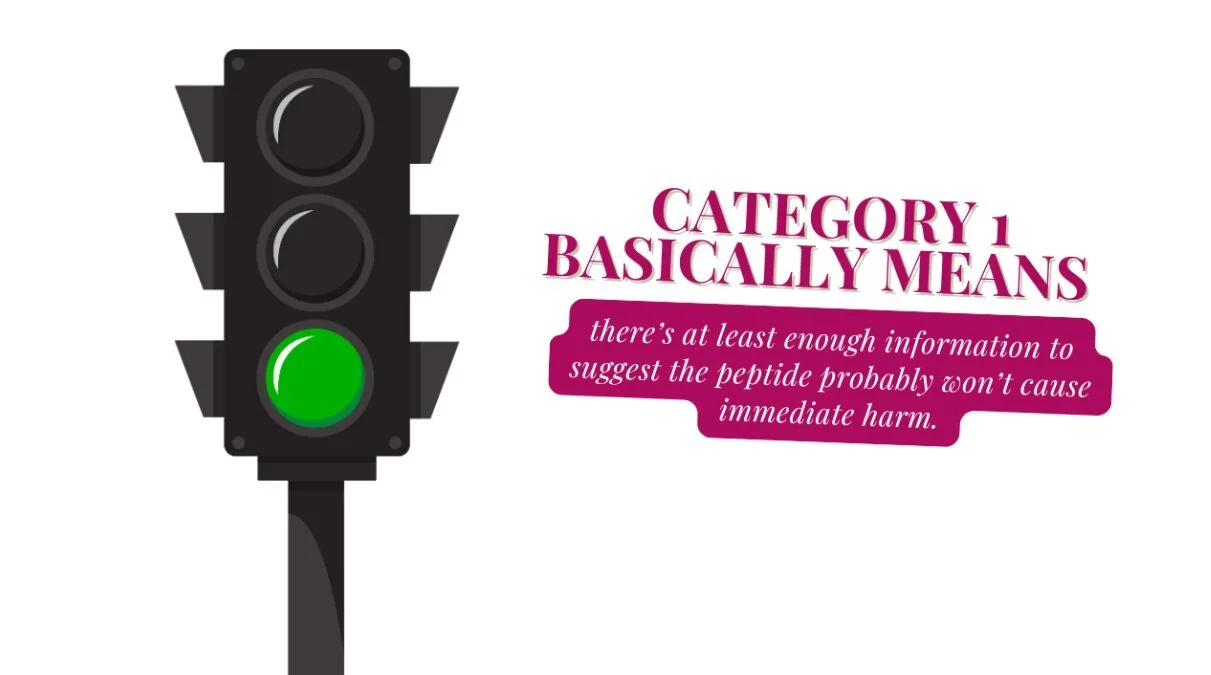
Within those smaller peptides, there are two main categories. Category 1 basically means there’s at least enough information to suggest the peptide probably won’t cause immediate harm. That’s it. It does not mean it’s FDA-approved, fully tested, or proven effective. It just cleared a pretty low bar. Category 2 is for peptides with little to no human safety data, or ones that may already show possible risks. Those aren’t supposed to be compounded for human use outside of research.
And honestly, this is where it gets messy. These categories aren’t always based purely on science. For example, PT-141 is an FDA-approved peptide with strong clinical trial data and real evidence behind it, but it still sits in Category 2 because of legal and patent reasons—not because it’s unsafe. Meanwhile, BPC-157 has no real Phase 1 human trial data and is still being considered for Category 1. That should make anyone pause.
So the category itself doesn’t tell you if something is safe or effective. It’s more of a regulatory label than a medical endorsement.
The problem is, a lot of marketing makes it sound like moving into Category 1 means a peptide is now legit and trustworthy. It doesn’t. It just means it may be easier to access. That’s a huge difference.
So instead of asking, “What category is this peptide in?,” the better question is, “What does the actual human research say?”
And for a lot of the peptides getting the most attention right now, the honest answer is still: not enough.
When a Key Unlocks the Wrong Door
One of the biggest and honestly least talked about risks with peptides isn’t just that we don’t have enough research yet. It’s that many of them aren’t very selective. They’re not like super precise tools that only do one thing. They’re more like a master key that can open a lot of different doors at once, and not every door leads somewhere you want to go.
Take Melanotan II, for example. It was originally made to increase melanin production, basically to help people tan. Sounds simple, right? But it doesn’t just affect tanning. It can also trigger other receptors in the body, which may impact things like sexual function, blood vessels, and heart health. There have even been reports linking it to melanoma and cardiovascular problems. So the concern isn’t just “does it work?” It’s also “what else is it turning on?”
That same issue shows up with healing peptides too. Something that helps tissue repair might also activate pathways linked to cancer growth. Biology isn’t neat like that. You can’t always switch on the “good” effect without potentially touching something harmful too.
Then there’s BPC-157, which is another peptide people talk about a lot. It was originally found in stomach juices and may have a natural role there. But when people inject it, it’s a completely different situation. Instead of staying in the stomach, it can travel through the bloodstream and reach the heart, brain, and basically the rest of the body. What works in one place doesn’t always behave the same way everywhere else, and we just don’t have enough human data to know what happens long term.
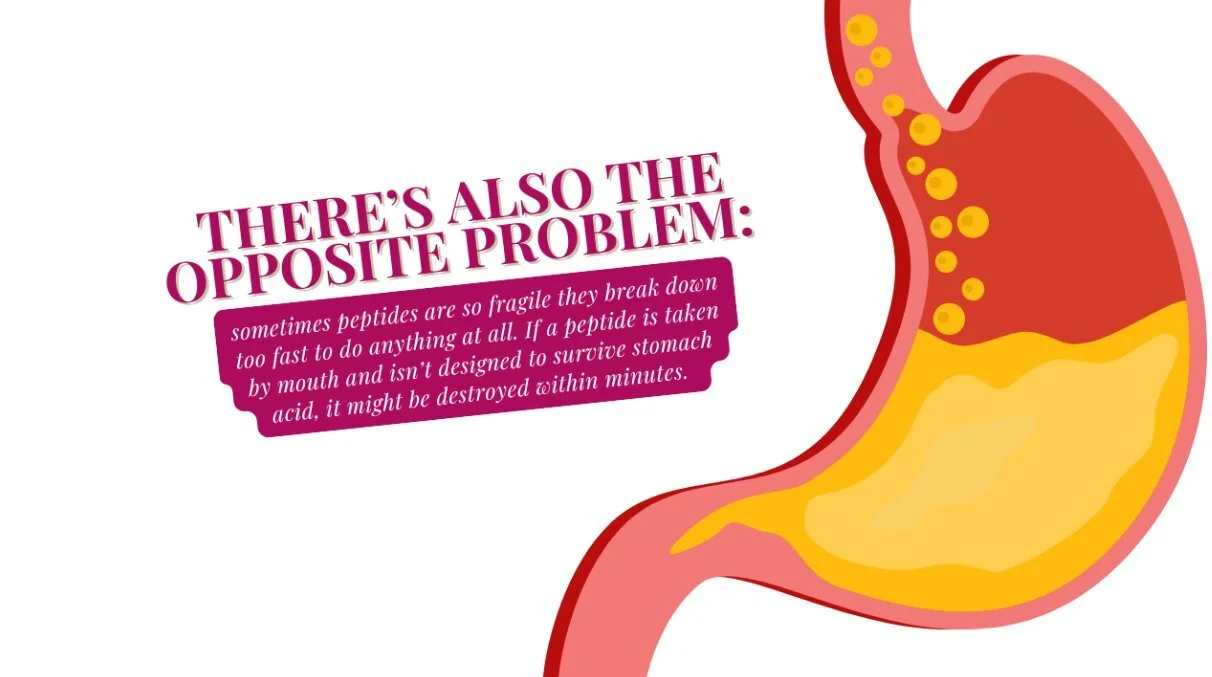
There’s also the opposite problem: sometimes peptides are so fragile they break down too fast to do anything at all. If a peptide is taken by mouth and isn’t designed to survive stomach acid, it might be destroyed within minutes. Which means some people could be paying for something that literally never makes it into the system.
So really, the risk goes both ways. Either it does nothing, or it works in ways we can’t fully predict. Neither option is exactly reassuring.
And statistically, only a small percentage of compounds even make it through early clinical trials and become approved treatments. Most of the peptides being hyped right now haven’t even made it that far.
That doesn’t mean peptides can never be useful. It just means we’re not there yet. A lot of things look promising in lab studies or animal research and then completely fail in humans. Sometimes risks don’t show up until years later.
So being cautious isn’t being negative. It’s just being smart. Good medicine means asking better questions before assuming something is safe just because it sounds promising.

Would I Ever Take One? An Honest Answer
When asked if he would ever personally take a peptide, Dr. Michael Albert gave a very honest answer: for most people, in most situations, the evidence simply isn’t strong enough to justify the risk.
That said, medicine is rarely black and white. Dr. Albert explained that it would take a very specific, near last-resort situation for him to seriously consider it. If someone had already exhausted legitimate, evidence-based treatments and was still dealing with significant pain or a major drop in quality of life, then certain peptides might be worth discussing more carefully.
He used chronic knee pain as an example. There are already many proven treatments that should come first, and that should always be the focus. But if someone had truly tried everything and the pain was severe enough to take away the parts of life that mattered most to them, then something like BPC-157 might cautiously enter the conversation, with full awareness of how much we still don’t know.
But when it comes to longevity, Dr. Albert’s concern gets much stronger.
A lot of peptides are being marketed as ways to live longer or optimize long-term health, but he pointed out that many people are looking at these before they’ve even handled the basics. Sleep, stress management, exercise, nutrition, and proven medical treatments are still the things we know make the biggest difference.
Before turning to an experimental peptide for longevity, his question is simple: have the basics actually been optimized first?
Because for most people, the gap between where they are now and what those fundamentals could do is huge.
He also pointed out something important about longevity claims: they’re almost impossible to prove in real time. If someone says a peptide might help you live longer, when would you even know if that was true? By the time any real answer shows up, years have passed, and the person promoting it has probably already moved on to the next trend.
That’s what makes it such an easy thing to sell and such a hard thing to verify.
So his bottom line was clear: if someone is dealing with a serious, treatment-resistant condition and has truly run out of evidence-backed options, that conversation may be worth having with a knowledgeable physician.
But if the goal is simply to live longer and “optimize” health, there are much better and much more proven places to start first. An unregulated peptide with no Phase 1 data isn’t a shortcut to better health. It’s just adding another unknown into the body and hoping for the best.
The Development History of BPC-157 Explained
If there’s one peptide that keeps showing up in wellness conversations, it’s BPC-157. People talk about it for recovery, pain, gut health, and faster healing, which makes it sound like it’s already a well-established treatment. But the reality is a lot more complicated.
Dr. Michael Albert explained that BPC-157 has actually been around for more than 30 years. It’s not new, and it’s definitely not some secret discovery. It has been discussed in pharmaceutical research for decades.
At one point, GlaxoSmithKline even held the license to develop it. That matters because companies like this have the funding, research teams, and real motivation to bring promising treatments to market. So when a major pharmaceutical company chooses not to keep developing something, it usually means the data behind it wasn’t strong enough to move forward.
There’s another detail people often miss. One of the original researchers behind BPC-157 registered a clinical trial on ClinicalTrials.gov back in 2015. The study was later canceled, and even though it was reportedly said to have gone well, the results were never officially published.
In clinical research, that matters. If results are strong and positive, they’re usually shared. When a study disappears without published findings, it raises questions. It could mean the results weren’t strong enough, there were safety concerns, or there were problems that made further development difficult.
This doesn’t automatically mean BPC-157 is dangerous. But it does mean people should be careful. It shouldn’t be treated like some miracle treatment that mainstream medicine ignored for no reason.
When important signs like these exist, they deserve attention.
At the end of the day, peptides sit in a really uncomfortable space right now. Not because they’re all good or all bad, but because we simply don’t have enough strong human research on most of them to speak with real confidence.
That lack of solid data is where most of the confusion comes from. It’s also where people make assumptions too quickly, either treating peptides like breakthrough solutions or dismissing them completely without looking at the full picture.
What this really comes down to is not hype versus skepticism. It’s evidence versus interpretation.
And right now, for most of the peptides being talked about online, the evidence just hasn’t caught up to the hype.
The goal isn’t to tell people what to do with their health. It’s to slow the conversation down enough so decisions are based on what we actually know, not just what we hope.
More from The Dr. Francavilla Show:
Subscribe to The Dr. Francavilla Show on