
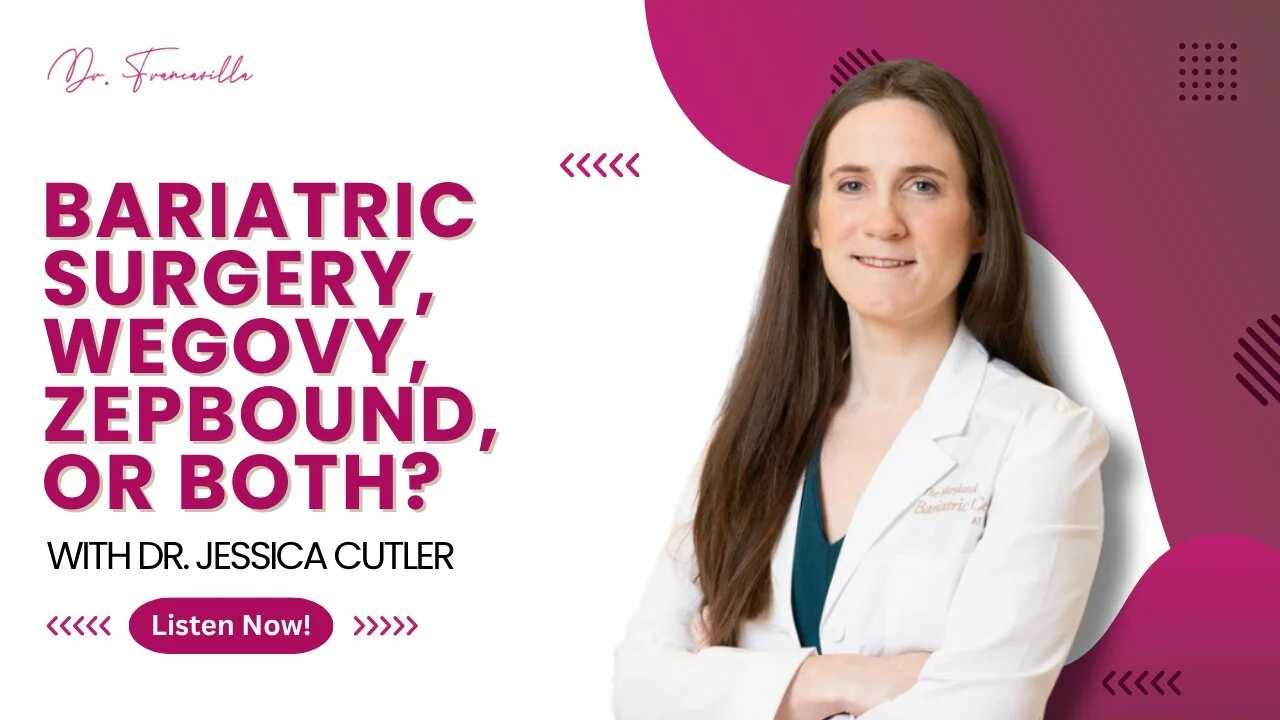
Bariatric Surgery, Wegovy/Zepbound or both? With Dr. Jessica Cutler
Have you ever wondered if weight loss surgery and medication are actually better together — or if choosing one means giving up the other?
That question sits at the center of one of the most important — and honestly most misunderstood — conversations happening in metabolic health right now. Most people approach weight loss like it's a multiple choice test: pick surgery, pick medication, pick diet and exercise, and stick with your answer. But the reality is so much more nuanced than that, and the patients who tend to do best are almost never the ones who commit to a single path.
Dr. Jessica Cutler is the kind of clinician who genuinely gets that. As both a bariatric surgeon and an obesity medicine specialist at Mercy Medical Center in Baltimore, Maryland, she works on both sides of this care in a way that's pretty uncommon — and incredibly valuable for her patients. She completed her medical degree at the University of Pittsburgh, her general surgery residency at Monmouth Medical Center in New Jersey, and went on to fellowship training in bariatric and minimally invasive surgery at Albany Medical Center in New York. That combination of surgical expertise and medical management in one provider is exactly why she's here — because this conversation needed someone who sees the full picture, not just one piece of it.
Clearing Up the Misconceptions About Bariatric Surgery
Honestly, one of the most common things that comes up when patients first sit down to talk about weight loss options is this immediate hesitation the moment surgery is mentioned. And well, it makes total sense — a lot of what people know about bariatric surgery comes from reality TV, and those portrayals don't exactly represent the full picture. Patients will often say, "That's not really what I look like, so I probably don't qualify." But here's the thing: bariatric surgery is appropriate for a much broader range of patients than most people realize. The media has basically created this very narrow image of who this surgery is "for," and it's keeping a lot of people from even exploring it as a legitimate option for their health.
The other fear that comes up — like, almost every single time — is the fear of failure. Most patients have seen someone in their life go through surgery and eventually regain the weight, and that experience sticks with them. It's completely understandable. If you've watched a family member or close friend go through something that difficult and not get the long-term results they hoped for, of course you're going to wonder whether the same thing will happen to you. What's important to understand though, is that weight regain after surgery is usually a sign that someone needed more support — not that surgery itself doesn't work. The surgery is a powerful tool, but it works best when it's paired with ongoing care, lifestyle changes, and sometimes additional medical support along the way.
That's really why having honest, upfront conversations early in the process matters so much. Patients deserve to know what surgery can and can't do, what the recovery actually looks like, and what kinds of support are available to help them maintain their results long-term. Surgery isn't a guarantee on its own — but with the right education and the right team behind you, it can genuinely be a turning point. The goal is never to push anyone toward a particular decision. It's to make sure that whatever you decide, you're making that choice with full information — and without fear getting in the way of what might actually change your life.

You Might Qualify for Bariatric Surgery — And Not Even Know It
One of the biggest changes in bariatric medicine over the past decade or so is how much the criteria for surgical candidacy has expanded — and honestly, not enough people know about it. Surgery has become significantly safer, which means the risk-benefit calculation looks really different now than it did even ten or fifteen years ago. Today, there's clear benefit for people with a BMI of 35 or higher, even without any other health conditions present. For those living with type 2 diabetes, that threshold drops to a BMI of 30 — and in certain ethnic populations, it can be even lower than that. So if you've been quietly assuming you're not a candidate, the honest answer is: depending on your health history, you very well might be. A lot of people are ruling themselves out before they've even had a single conversation, and that's worth addressing directly.
The best first step — truly the lowest-pressure thing you can do — is just showing up for a consultation. There's no commitment involved, no operating room waiting for you at the end of the hallway. It's just a conversation. Coming in to ask questions, understand your options, and get real information tailored to your specific situation is always worthwhile, even if surgery ultimately turns out not to be the right path for you. The goal of that first appointment is simply to make sure the right options are actually on the table — because you can't make a fully informed decision about something you've never had properly explained to you.
One group that really deserves a specific mention here is people living with type 2 diabetes. A lot of these patients are already on GLP-1 medications like Ozempic or Mounjaro, and their blood sugar numbers may look great on paper — which is genuinely wonderful. But weight loss is often a completely separate and much harder battle. Type 2 diabetes makes losing weight significantly more difficult, and medication alone doesn't always move the needle the way patients need it to. For someone in that situation — well-managed diabetes but little to no progress on weight — surgery deserves a real place in the conversation as part of a comprehensive treatment plan. It's not about pushing anyone toward a decision. It's about making sure that decision gets to be a real, informed one.
Bariatric Surgery and Type 2 Diabetes: There's Way More to This Story Than Weight Loss
When most people think about bariatric surgery, weight loss is the first — and often only — thing that comes to mind. Which is totally understandable, but it's actually only part of the picture. One of the most significant and genuinely under-discussed aspects of this surgery is what it does for type 2 diabetes — and it's a big reason why the field is now officially called metabolic and bariatric surgery, not just bariatric surgery. Here's what makes it so remarkable: surgery is currently the only intervention that can effectively put type 2 diabetes into full remission. Today's medications — including the GLP-1 drugs that are everywhere in the conversation right now — are really excellent at managing and controlling blood sugar. But that's the key word: managing. The moment those medications stop, blood sugar typically rebounds and the diabetes comes right back. Surgery creates something fundamentally different.
What's really fascinating from a clinical standpoint is that even in patients who experience some weight regain down the road, we don't see the diabetes return at the same rate. The two don't move in lockstep the way you might logically expect them to. That tells us something really important — that surgery is creating lasting metabolic changes that go well beyond whatever number shows up on the scale. This isn't just a weight loss story. It's a story about the body's hormonal and metabolic pathways being genuinely, durably restructured in a way that no pill or injection is currently able to replicate.
This matters most for patients who are already doing everything right — taking their medications, managing their numbers, following their care plan — but still struggling to lose weight. Because here's the thing: type 2 diabetes itself makes weight loss harder, and that's true even with the best medications available. So for someone in that situation, surgery isn't just another option to consider for the scale. It's a metabolic intervention that can address the underlying condition in a way that nothing else currently can. If you're managing type 2 diabetes and feel like you've genuinely hit a ceiling with your current treatment plan, it's worth having a real conversation about whether a stronger tool belongs in the mix.
GLP-1s Changed Everything — Here's How Good Bariatric Care Adapted
The arrival of medications like Zepbound and Wegovy has genuinely shaken up the world of bariatric surgery in a way that's hard to overstate. These drugs became more accessible, better covered by insurance, and more front-of-mind for patients almost overnight — and the impact on surgical volume across the field was immediate and measurable. But here's the thing: the surgeons and practices that are doing really well right now aren't the ones who pushed back against medications or dismissed them as a trend. They're the ones who asked a much more productive question — how do we make all of these tools work together for our patients? Because the reality is that most patients who walk into a consultation don't arrive with a fixed idea of what they want. They have a goal. They want to feel better, move more freely, get off certain medications, or hit a health milestone.
That openness is actually a really good thing, because it means there's space to have an honest, thorough conversation. A good initial consultation should lay out the full landscape — lifestyle changes, GLP-1 medications, surgical options — with realistic expectations for each path and, practically speaking, a real conversation about cost and insurance coverage too. From there, the patient gets to decide where they want to focus, with the understanding that nothing is set in stone. If one approach isn't delivering results, you reassess. You ask what else might help. You layer in additional support. That kind of ongoing, evolving care is genuinely what gets people to their goals — and it's exactly what gets lost when care becomes too transactional or too convenience-driven.
Which brings up something worth saying directly: the rise of online prescription services has its place, but there's a real risk in a model that just sends medication without asking the harder questions. Is this actually the right intervention for this person? Would they be better served by a surgeon, a dietitian, or a closer look at something like hormonal changes or underlying metabolic conditions? Your body is not a drive-through menu — you don't just pick one thing and assume it's the perfect fit forever. Weight management is rarely a one-intervention journey, and the patients who do best long-term are almost always the ones whose care evolves with them. The goal is providers who keep reassessing, keep asking whether what they're doing is working, and aren't afraid to change course when it isn't.
The Best of Both Worlds: Why Surgery and Medication Work Better Together
If there's one thing worth understanding about modern weight loss care, it's that no serious result usually comes from just one tool. Like, you're not building a house with a single screwdriver — and your body isn't any different. One of the most exciting shifts happening in bariatric medicine right now is the growing recognition that surgery and medication aren't competing options. They're complementary ones, each filling in where the other falls short. For a long time, both surgeons and patients operated under this all-or-nothing assumption — that surgery was a singular, definitive decision, and if it didn't fully work or the weight came back, the options were basically exhausted. That's simply not true, and it's a misconception that's worth clearing up directly. Surgery remains the most powerful and durable tool we have, but it was never meant to carry the entire journey on its own.
What's really changed is the understanding of how meaningfully medication can support patients at multiple points along the way — not just after surgery, but before it too. For someone whose weight makes an operation higher-risk, starting a GLP-1 medication beforehand can lower that risk in a really significant way before they ever step into an operating room. For someone who wants to try medication first — whether out of personal preference or just to see how their body responds — surgery remains a viable path if results plateau or insurance coverage changes. And for patients who are post-surgery and either not losing as much as they hoped or starting to see weight creep back, medication can provide that extra layer of support that keeps progress moving. The journey doesn't have a fixed endpoint, and the tools available don't have to either.
That said, timing does matter — especially when it comes to restarting or starting a GLP-1 after surgery. In the first couple of months post-op, appetite is already significantly suppressed, and layering in a medication that further reduces hunger can actually cause issues like dehydration or not getting adequate nutrition. So it's not something to do casually or without guidance. Most of the research to date has focused on patients who are at least two years out from surgery, often more. But newer data is starting to emerge around earlier use — as soon as six months post-op — with genuinely promising results, particularly for patients who hit their first plateau sooner than expected. The science is catching up to what a lot of clinicians were already starting to see in practice, and that's a really good thing for patients navigating this journey.
What Bariatric Surgery Can — and Can't — Do for You
Bariatric surgery is genuinely remarkable at what it does on a physiological level, and it's worth understanding exactly why. Sleeve gastrectomy, for instance, works strongly on the ghrelin pathway — that's the hormone largely responsible for driving hunger — which is a big part of why patients feel so much less hungry in the months following surgery. Gastric bypass has well-documented effects on postprandial GLP levels, meaning the hormones that regulate hunger and blood sugar after meals shift in really meaningful ways. These are lasting, physiological changes that medications alone can't fully replicate, and they're a big reason why surgery remains the most durable option we have. The metabolic and microbiome-related factors behind weight gain? Surgery addresses those in a way that nothing else currently comes close to matching.
But surgery also has real limits, and being honest about those limits is just as important as celebrating what it does well. It doesn't do much for the brain's reward pathways — the ones involved in binge eating, compulsive eating, or what a lot of patients describe as food noise, that persistent, intrusive mental chatter about food that just doesn't quiet down. It doesn't address genetic predispositions to weight gain. And it absolutely cannot fix the external factors that quietly undermine progress over time — chronic stress, poor sleep, a demanding or chaotic lifestyle. Surgeons are talented, but they're not brain surgeons or wizards. Those factors matter enormously, and they fall outside what any operating room can reach.
That's exactly where medication becomes such a valuable complement — and honestly, it's the piece that ties everything together. Patients who struggle with food noise tend to plateau earlier or experience regain over time, because the surgery is doing its job on the body but not necessarily on the brain. For these patients, adding a GLP-1 or another targeted medication can address what surgery left untouched, helping sustain weight loss and genuinely improving quality of life in a way that neither approach could fully achieve on its own. The takeaway is pretty straightforward: surgery and medication aren't in competition with each other. Used thoughtfully, they're complementary tools — and the patients who tend to do best long-term are the ones whose care is flexible enough, and whose providers are open-minded enough, to use both.
The Gut Feeling We Can't Ignore: Bariatric Surgery and Your Microbiome
There's a piece of the weight loss conversation that genuinely doesn't get enough airtime, and that's the gut microbiome. It doesn't come up often in clinical settings — partly because we still don't fully understand it, and partly because we don't yet have a lot of reliable ways to directly intervene on it. But the science is, like, genuinely fascinating, and it's increasingly looking like the microbiome may be one of the most important frontiers in metabolic health that we haven't fully cracked yet. What lives in your gut — the specific balance of bacterial species — appears to have a real and meaningful impact on weight, metabolism, and how your body responds to different interventions. And bariatric surgery, it turns out, seems to change that balance in ways that go well beyond what most people expect from a weight loss procedure.
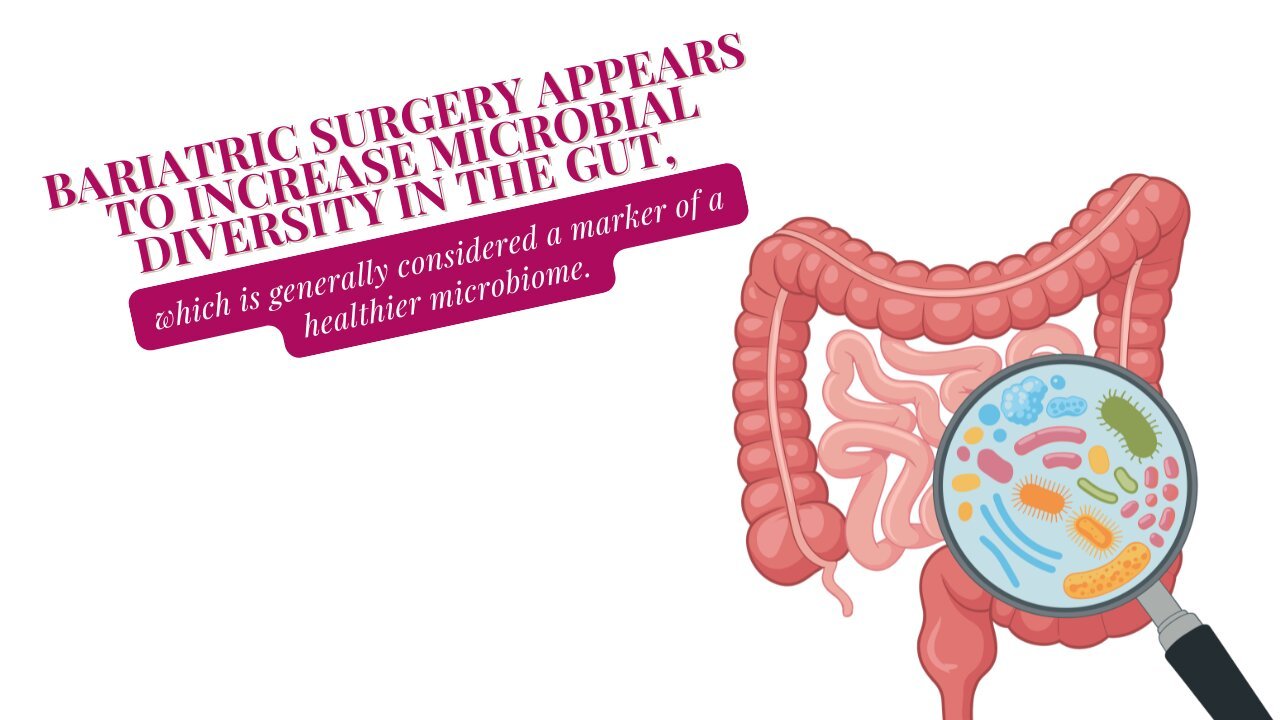
Here's what the research is showing: bariatric surgery appears to increase microbial diversity in the gut, which is generally considered a marker of a healthier microbiome. After surgery, the balance of bacteria shifts — more of what might loosely be called "weight loss-friendly" species start to take hold, and the bacterial profiles more commonly associated with obesity seem to decrease. It's a meaningful change, even if the exact mechanism isn't entirely clear yet. Does the surgery directly cause the microbiome shift, or does the weight loss itself drive it? That chicken-and-egg question hasn't been fully resolved. But the association is consistent enough across the research that it's really hard to ignore — and it adds another layer to why surgery produces such durable metabolic results for so many patients.
This is also part of what makes bariatric surgery so much more than just stomach resizing — and honestly, that early framing of the procedure did the field a bit of a disservice. The original working theory was pretty straightforward: make the stomach smaller, eat less, lose weight. Simple enough. But that explanation has turned out to be way too narrow. What's actually happening is a complex, multi-layered reshaping of hormonal and metabolic pathways — and the microbiome appears to be a meaningful part of that picture too. Surgery isn't just changing how much food fits in your stomach. It's, like, fundamentally changing how your body processes and responds to food at a biological level. And the more we understand about that, the more powerful and precise our approach to treating obesity is going to become.
The Future of Weight Loss Medicine Is Closer Than You Think — But the Body Is Still Surprising Us
Other interventions are already showing some real promise when it comes to the microbiome, which is exciting. Metformin, for instance, has been associated with favorable shifts in gut bacteria — and that may actually explain some of its metabolic benefits that go beyond just blood sugar control, which is a really interesting layer that doesn't get talked about enough. Nutrition strategies and targeted supplements are also being actively explored as ways to support a healthier microbial environment, though the evidence there is still mixed and tends to be highly individual. What works really well for one person's gut doesn't necessarily translate to the next. So while there are tools worth exploring, the honest answer is that we're still in relatively early territory when it comes to reliably manipulating the microbiome in a clinical setting.
And look — most people in this field will tell you openly that we expected to be further along by now. The idea of a precisely engineered probiotic capsule that shifts the microbiome in ways that meaningfully support weight loss? Genuinely compelling, and it may well become a reality. The concept of a simple cheek swab or genetic test that could predict which medication or intervention will work best for a specific patient has felt just around the corner for years. But the body keeps humbling even the best predictions, because it is extraordinarily complex in ways that continue to surprise researchers and clinicians alike. That's not a discouraging thing — it's just an honest acknowledgment of where the science actually is right now versus where we hoped it would be.
What that complexity really underscores is why the scientific process matters so much — and why it's worth trusting even when progress feels slow. Hypotheses get tested, assumptions get challenged, and understanding evolves. Bariatric surgery's own history is a perfect example of this: what started as a pretty mechanical solution — make the stomach smaller, eat less — turned out to be a deeply physiological intervention with effects on hormones, metabolism, and now the microbiome that nobody fully anticipated at the outset. That's not a failure of early thinking. That's just how medicine moves forward. The microbiome may very well be the next big chapter in that story, and for anyone navigating weight loss today — whether through surgery, medication, or a combination of both — it's a good reminder that the best care is always the kind that stays curious about what it doesn't yet fully understand.
If this conversation opened up some new questions for you — or made you rethink options you may have already written off — the full episode is absolutely worth your time. Dr. Cutler goes even deeper on all of these topics, bringing the kind of clinical insight and real-patient perspective that genuinely doesn't fit into a single blog post. Whether you're just starting to explore your options or you've been navigating this journey for a while, there's something in this conversation for you.
More from The Dr. Francavilla Show:
Subscribe to The Dr. Francavilla Show on