
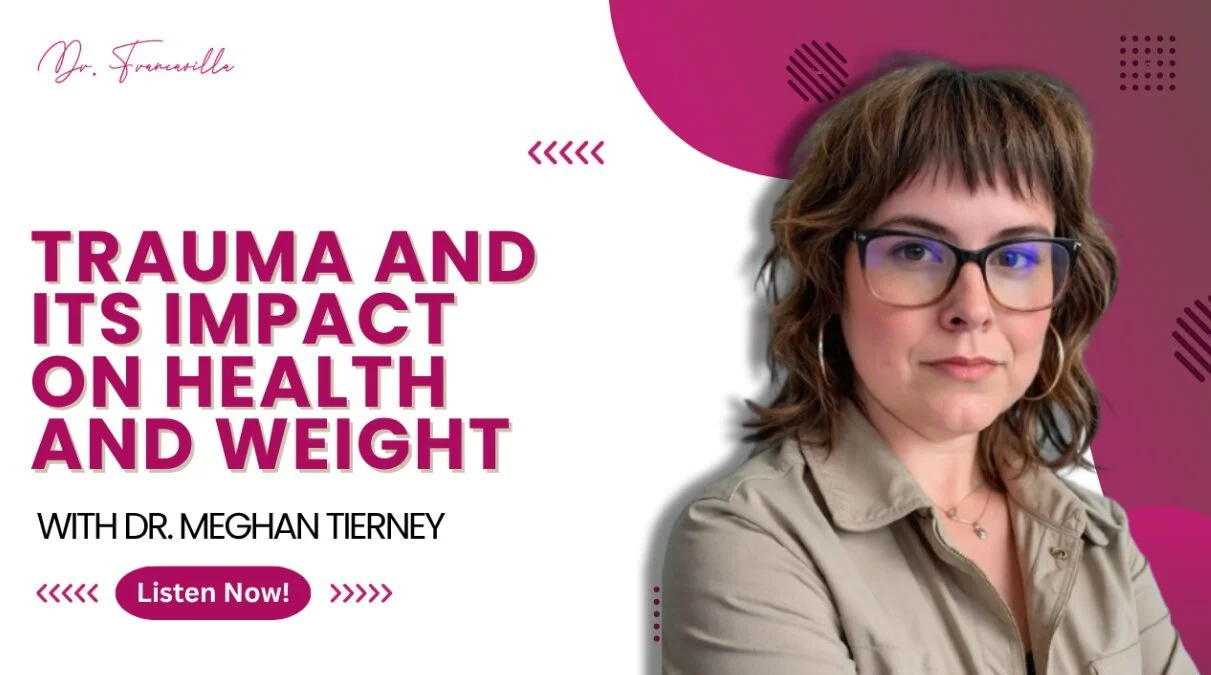
Trauma and Its Impact on Health and Weight with Dr. Meghan Tierney
Have you ever done everything right, from workouts to meal plans to early bedtimes, and still felt like your body was working against you?
What if the missing piece wasn't a better diet or a stricter routine, but something that happened to you years, maybe even decades, ago?
Today’s conversation focuses on trauma — what it really is, how it quietly reshapes biology, and why it matters when it comes to health, weight, and even the way conversations unfold with a healthcare provider. It’s not always an easy topic to sit with, which is exactly why it often gets overlooked. But it’s also one that deserves more attention.
Joining the discussion is Dr. Meghan Tierney, a board-certified family physician, obesity medicine specialist, and Menopause Society certified practitioner. She is the founder of Sorrel Health and Wellness in Seattle, Washington, where she supports women in midlife through perimenopause, menopause, and metabolic health challenges using evidence-based, weight-neutral care that blends medical treatment with mindfulness and self-compassion.
As time goes on, the connection between health and trauma becomes harder to ignore. Many patients dealing with persistent weight and health challenges have also lived through difficult experiences. This pattern reflects real biological changes linked to trauma. Understanding it can reshape how health is approached, making room for more compassionate care. Keep reading to learn how trauma affects the body and what that can look like in everyday life.
What Do We Actually Mean by Trauma?
When we talk about trauma in a clinical context, one of the most well-known frameworks is the ACEs score — Adverse Childhood Experiences. This came from a large-scale study in the '90s involving thousands of participants, and it measures 10 specific childhood experiences linked to long-term health outcomes: things like abuse, neglect, having a parent with serious mental illness or addiction, or simply growing up feeling unwanted. It's a useful starting point — but it's honestly a pretty narrow lens. It doesn't capture systemic racism, socioeconomic hardship, chronic bullying, or the quieter, harder-to-name experiences that can leave just as deep an impression. The numbers give us a framework, but the real picture always lives in the story.
That's where the concept of Big T and little t trauma becomes really helpful. Big T trauma is what most people picture when they hear the word: physical, sexual, or verbal abuse; neglect; feeling fundamentally unloved or unwanted; having a parent who was incarcerated. Systemic racism and prolonged bullying belong here too — the weight and duration of those experiences make them Big T, full stop. Little t trauma is subtler, but it's still very real. Moving frequently as a kid, struggling with an undiagnosed learning disability and never quite feeling like you fit in, or witnessing something frightening even just once — these aren't the "big bad scaries," but they shape people in lasting ways, often without anyone, including the person themselves, fully realizing it.
Here's the thing though — whether it's a Big T or little t, trauma in all its forms leaves a mark. And understanding the full spectrum is like the first step to understanding how it shows up in someone's health, their relationships, and the way they move through the world. It's not about ranking whose experience was harder. It's about recognizing that if something affected you, it counts — and it deserves to be taken seriously.
What Trauma Actually Does to Your Body
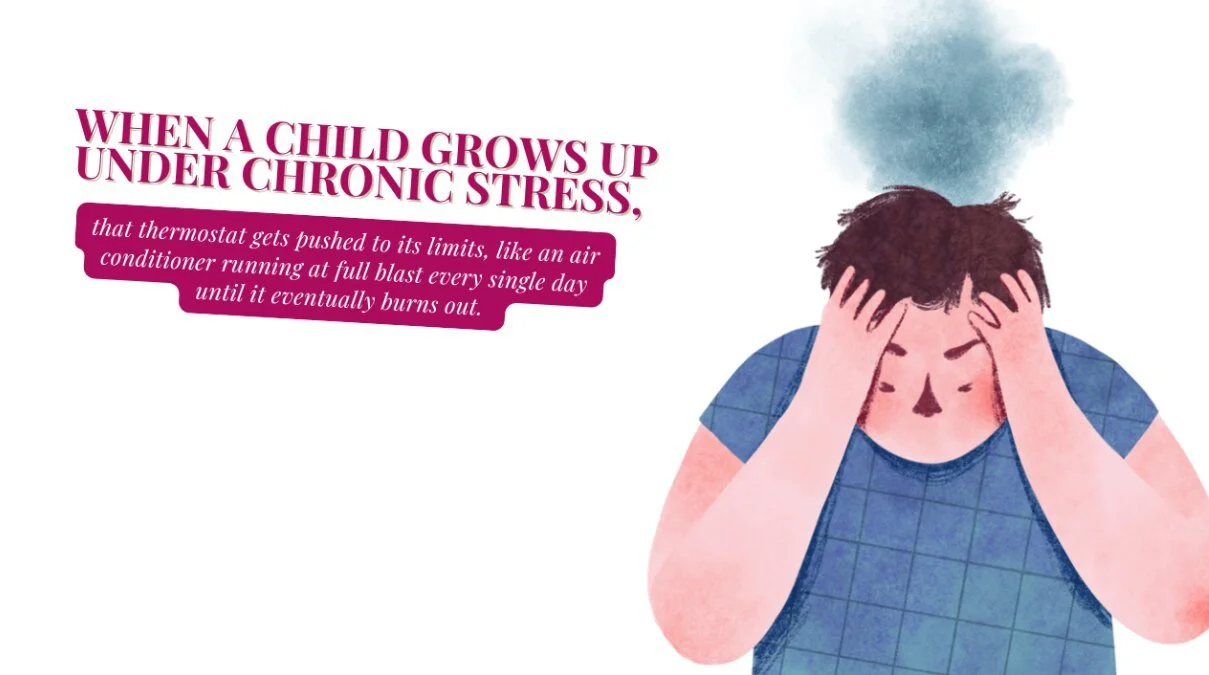
It might surprise you just how much our lived experiences shape our biology — like, genuinely shape it at a cellular level. The mind and body aren't separate systems operating independently; they're deeply, constantly talking to each other. At the center of that conversation is something called the hypothalamic-pituitary axis — essentially the brain's master thermostat, regulating hormones and keeping all your major systems in balance. When a child grows up under chronic stress, that thermostat gets pushed to its limits, like an air conditioner running at full blast every single day until it eventually burns out. The result is chronically elevated cortisol, your body's primary stress hormone — and cortisol doesn't just make you feel stressed. It actively changes how your body processes glucose, responds to insulin, and stores energy. So even if someone is doing all the "right" things — eating well, exercising, getting enough sleep — if this system has been dysregulated for years, maintaining a healthy metabolism becomes genuinely harder. That's not a willpower issue. That's biology.
The immune system gets pulled into this too. A body that's spent years in survival mode keeps its immune system running on high alert, which leads to chronic baseline inflammation. That inflammation further disrupts metabolic function, contributes to fat storage around the midsection, and can leave people feeling generally unwell much of the time — not because of a true immune deficiency, but because that system has simply never had a chance to power down.
And then there's the epigenetic layer, which is honestly kind of mind-blowing: chronic stress actually changes how genes express themselves, altering the very instructions your cells use to operate. On top of that, research has shown that adverse childhood experiences affect the gut microbiome — not only in the person who experienced them, but potentially in their children as well. Since the gut microbiome influences how many calories the body absorbs, early trauma quietly affects even that calculation. Trauma, in other words, touches the whole system. Hormones, metabolism, immunity, genetics, digestion — all of it.
This is exactly why it's so important to move away from the idea that people with chronic health conditions just aren't trying hard enough, or that their symptoms are somehow "in their head." There is real, documented biology behind why someone who has experienced significant stress or trauma may struggle more with their weight, their immune health, or their overall wellbeing than someone who hasn't. The same shift we've seen in how we talk about obesity — away from blame, toward understanding the underlying physiology — applies here too. And if no one has told you this lately: it's not your fault. Blaming yourself for where you are doesn't change the biology — but understanding it does. That's not an excuse. It's context. And context is where healing actually begins.
So What Do We Actually Do About It?
Knowing that trauma has real, lasting effects on the body is important — but the next question matters just as much: what do we actually do with that information? For anyone who recognizes their own story in what we've talked about, the work starts on the inside. And yes, it is work. Self-compassion and mindfulness aren't just feel-good buzzwords — they require genuine, consistent daily practice. It's not enough to hear it once from someone who loves you, as meaningful as that is. The real shift happens when you start saying it to yourself, and when you become aware of the moments you stop — because the moment you stop is usually when things start to unravel.
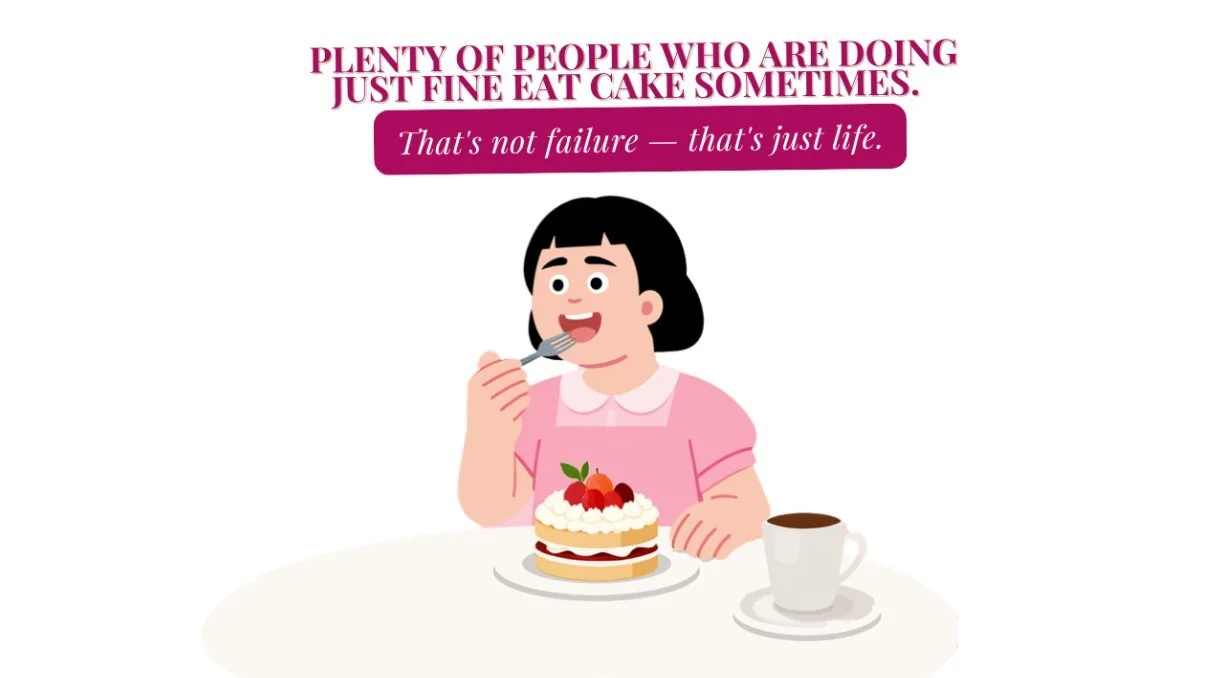
Here's what that unraveling looks like in practice. You decide you're ready to make some changes — maybe around food, movement, your health overall. You set an ambitious plan, push through for a few weeks or even a couple of months, and then life happens. You miss a week. And in that moment, every harsh thing you've been telling yourself to stay motivated suddenly feels like proof. Of course. I knew I was lazy. This always happens to me. That inner voice — the one that sounds like a boot camp instructor — can feel incredibly motivating at the start, but it has no durability. When things get hard, it doesn't build resilience. It destroys it. And we see this play out on an even bigger scale too — some people genuinely muscle through six months, even a year of strict focus; then one missed gym day or one piece of pie, and it all feels over. Because the thinking is binary: either everything is perfect, or everything has failed. But that's not how health works. Plenty of people who are doing just fine eat cake sometimes. That's not failure — that's just life.
The alternative to all-or-nothing thinking looks something like this: That was a really hard week. I needed rest, and I took it — and that matters. This week, I'm going to go once. Once feels doable. Once is enough. That's not lowering the bar — that's like, actually building something sustainable. A relationship with yourself and your goals that can survive the hard weeks instead of collapsing under them. For people carrying the weight of past trauma, the ability to keep coming back with kindness after every setback isn't a soft skill. It might honestly be the most important health practice of all.
Food, Coping, and Why It's Not Your Fault
It’s hard to talk about trauma and coping without bringing up food, and there’s a clear biological explanation for why. Most kids aren’t reaching for alcohol or other adult coping tools when life feels overwhelming, but food is often available and quickly becomes an early form of self-soothing. Highly palatable foods — especially those high in sugar and fat — activate the brain’s reward system, triggering dopamine release, endogenous opioids, and measurable calming effects like reduced stress and lower heart rate. Even something as simple as labeling food as a “treat” can reinforce this response over time. This connection is learned early in life, often unintentionally, as comfort gets tied to eating through everyday patterns like dessert being framed as a reward. In fact, this response is so deeply biological that even in newborn care, sugar solutions are sometimes used for pain relief because sweetness itself has a calming effect on the nervous system.
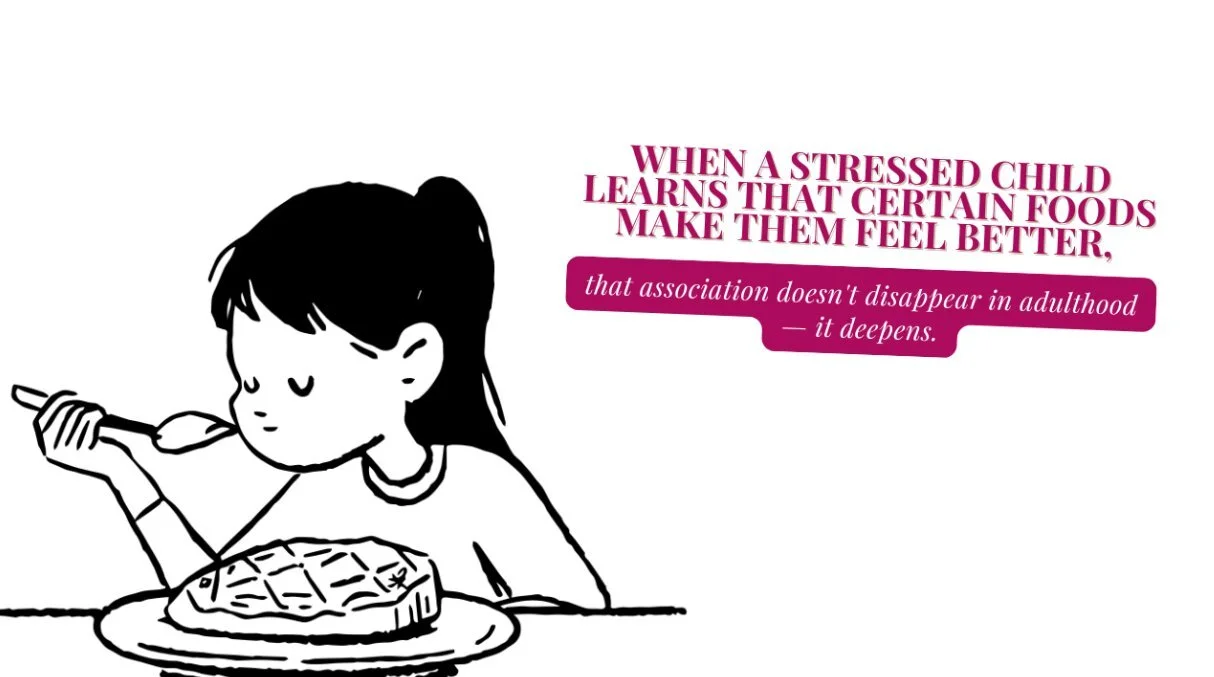
So when a stressed child learns that certain foods make them feel better, that association doesn't disappear in adulthood — it deepens. Adverse childhood experiences also affect the prefrontal cortex, the part of the brain responsible for executive function and decision-making. Add diminished impulse control to a deeply ingrained comfort response, layer in a gut microbiome shaped by early stress that now prefers those same foods, and you start to see just how many biological forces are quietly working together.
To be clear though: using food to cope isn't the worst thing. It's far less immediately harmful than a lot of other coping mechanisms people turn to. Soothing with food sometimes, celebrating with it, letting chocolate fix a bad day — that's human, and it's okay. The concern is when it starts to interfere with daily life, or escalates into patterns like binge eating that feel out of control. If you're experiencing episodes where eating feels compulsive or overwhelming, that's genuinely worth talking to someone about. There are evidence-based approaches — including specific therapies and medications — that can really help.
And perhaps the most important thing we can do in that conversation is remove the shame from it. There is already so much shame attached to having experienced trauma — and then there's like an added layer around the ways people found to survive it. But that's exactly what these coping mechanisms are: survival strategies. You did what you had to do to get through, and that deserves compassion, not judgment. When patients share these things with their doctors — whether it's emotional eating, binge episodes, or just a complicated relationship with food — the goal isn't to call anyone out. It's context. The more a healthcare provider understands about what someone has been through, the better equipped they are to actually help. If you've ever felt too ashamed to be fully honest with a doctor about your eating habits, know that a good provider wants to hear it — not to shame you, but to understand you. And if you're in a clinical relationship where you don't feel safe being that vulnerable, that's worth paying attention to. You deserve care that meets you with compassion.
Stress, Sleep, and Why This Is Not Your Destiny
Trauma isn't only something that happens in childhood — adults experience it too. And even when it doesn't rise to the level of a capital-T traumatic event, chronic everyday stress takes a very real toll on the body. Think about a single mom working two jobs to keep the lights on. Or a driven entrepreneur who's built something successful but hasn't slept more than five hours a night in years. Or a college student quietly unraveling under the pressure to perform. None of these experiences look the same, but the physiological effect of living under constant stress is strikingly similar across all of them — and it matters enormously when it comes to health. This is why stress management and sleep aren't just lifestyle suggestions. They're like, genuinely the foundation. Movement that feels good — not punishing, but enjoyable. Seven to eight hours of sleep. Some form of stress relief that's actually sustainable for you, whether that's meditation, a creative hobby, yoga, or running. These aren't extras you get to once everything else is handled. They're the base layer that nutrition, weight management, and metabolic health all get built on top of.
That said, it's also the hardest thing to prescribe. A physician can hand someone a meal plan or recommend a medication, but sustainable stress reduction requires real internal commitment — and that's not something anyone can do for you. The good news is that when people do prioritize it, results tend to follow in a pretty significant way. Reduce the chronic stress load, and a lot of other things start falling into place. It's one of the most consistent patterns we see clinically, and it's worth taking seriously even when it feels like the least urgent item on your list.
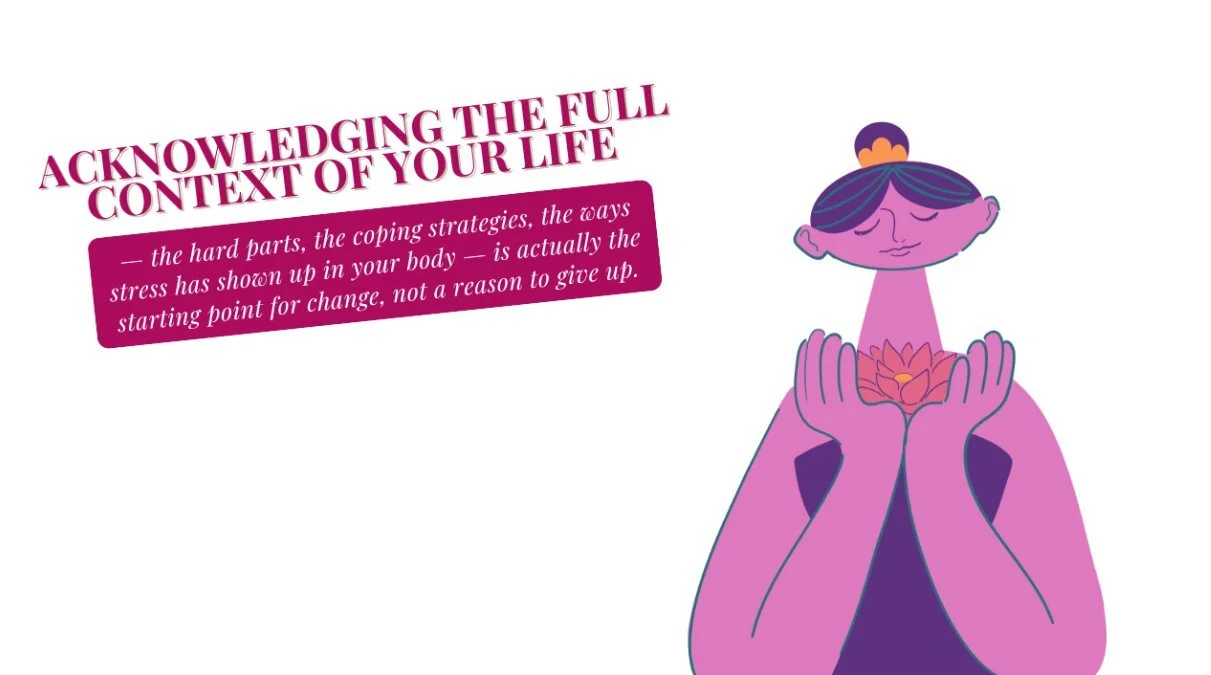
And if there's one thing to take away from everything we've covered, it's this: biology is an explanation, not a life sentence. Yes, adverse childhood experiences can alter hormones, metabolism, immune function, genetics, and gut health. Yes, chronic stress compounds those effects. Yes, some people are carrying a heavier biological burden than others through absolutely no fault of their own — and that deserves to be fully acknowledged. But none of it is fixed. Acknowledging the full context of your life — the hard parts, the coping strategies, the ways stress has shown up in your body — is actually the starting point for change, not a reason to give up. Whether that looks like therapy, working with a compassionate healthcare provider, building a stress management practice, or simply learning to speak to yourself with more kindness, there is a real path forward. You are not behind because you lack discipline. You are not struggling because something is fundamentally wrong with you. You are navigating a body and a mind shaped by real experiences — and with the right support, sustainable change is absolutely possible.
But it’s not just about understanding the science — it’s about what comes next.
If any part of this felt familiar, that’s not something to ignore. It’s something to get curious about. Because the patterns, the struggles, even the setbacks… they don’t come out of nowhere. They have context. And when you start to see that clearly, it changes how you respond to yourself.
Not with pressure. Not with all-or-nothing thinking. But with a little more patience, a little more honesty, and a lot more compassion.
This isn’t about fixing everything overnight. It’s about building something that actually lasts — a way of taking care of your health that can hold up even on the hard days.
And if this conversation resonated, there’s more to unpack in the full episode.
More from The Dr. Francavilla Show:
Subscribe to The Dr. Francavilla Show on