
Calorie Counting and Logging- Should you do it and what to know
Have you ever wondered if counting calories is actually worth your time — or if it's just another diet trap dressed up in a tracking app? In this week’s episode, we talk about exactly that, and the answer is more nuanced than a simple yes or no. Calories are real, they matter, and paying attention to them can be genuinely useful — but the way most people approach calorie counting is often where things go sideways.
Let’s get right into it.
Why Not All Calories Are Created Equal
A calorie is simply a unit of energy — specifically, the amount of heat needed to raise the temperature of one milliliter of water by one degree Celsius. In the US, when we talk about food calories, we're actually referring to kilocalories, or 1,000 of those units. The way calories in food are traditionally measured is through combustion: the food is literally burned in a device called a calorimeter, and the energy released is recorded.
But here's the thing — you are not a calorimeter. The way your body processes food is fundamentally different from burning it in a styrofoam cup. Your body digests, it responds hormonally, and it reacts differently depending on what you're eating, not just how much. Protein, for example, requires more energy to digest, so you're already burning some calories just by eating it. Fiber can't be digested at all, so those calories don't even count toward what your body actually uses. And different foods trigger very different responses in blood sugar, hunger hormones, and feelings of fullness — all of which matter far more than the number on the label.
Take 100 calories of apple juice versus 100 calories of an actual apple, or better yet, apple slices with a little peanut butter. The juice hits your bloodstream fast, spikes your blood sugar and insulin, then leaves you hungry again almost immediately. The whole apple slows things down — the fiber takes longer to digest, keeps you fuller, and supports a healthier blood sugar response. Add a bit of peanut butter, and now you've got protein and fat working together to keep you satisfied even longer. Same calorie count, completely different experience in your body. That's why obsessing over calories alone misses the bigger picture — and why understanding the quality of what you eat matters just as much as the quantity.
Macros, Metabolism, and Why Your Body Isn't a Machine
Before diving deeper into how the body handles food, it helps to understand macronutrients — the three main categories of nutrients that make up the calories in what we eat. Fat, carbohydrates, and protein each carry a different caloric load per gram: fat has nine calories per gram, while both carbohydrates and protein come in at four. That's why fat can add up so quickly in a diet — a small amount packs more than twice the calories of the same weight in carbs or protein. There's technically a fourth macronutrient, alcohol, which clocks in at seven calories per gram, but ideally that's not a major part of the picture.
Now, one of the most important things to understand in the world of weight management is that the "calories in, calories out" model, while not entirely wrong, is a significant oversimplification. When the body is in a calorie-restricted state, it adapts — metabolic rate slows down, hunger increases, and feelings of fullness decrease, all driven by hormonal shifts. The same thing happens with exercise: the more you do a specific movement, the more efficient your body becomes at it, which means you burn fewer calories over time doing the same workout. The body is constantly recalibrating, which is why simply eating less and moving more rarely works as a long-term strategy on its own.
That said, calories aren't meaningless — they still matter. It's just that they're one piece of a much larger puzzle that includes hunger and satiety hormones, food reward pathways, stress, sleep, aging, menopause, gut health, and more. The goal in modern weight management isn't to obsess over every calorie, but to understand that the body is not a machine. It interacts with food in deeply personal and complex ways. Having a general awareness of how much you're eating is still a valuable foundation — it just shouldn't be the only tool in the toolbox.
Log Like a Scientist, Not a Judge
Calorie counting does work — and there's solid behavioral research to back that up. Studies comparing vastly different diet approaches, from keto to low-fat plant-based to point-based systems, have consistently found that no single diet is superior. What actually predicts success is how well someone sticks to whatever approach they choose. And the reason any of them work comes down to one thing: awareness. When you start paying attention to what you're eating, you naturally start making more intentional choices. That's the real mechanism behind logging, and it's why it's worth doing.
That said, calorie tracking doesn't work the same way for everyone. Some people find it too rigid and end up rebelling against it. Others turn it into a game — finding loopholes or over-focusing on hitting specific numbers in ways that backfire. And for many, it simply becomes burdensome and starts to feel like a daily judgment. That's why the approach matters just as much as the act of logging itself. The most helpful framing is to log like a scientist: not to restrict, not to grade yourself, but purely to observe. If you've never tracked before, try logging everything for a week or two without setting any rules. Just notice where your calories are coming from, how much protein you're actually getting, where added sugar is sneaking in, and what patterns show up across your day.
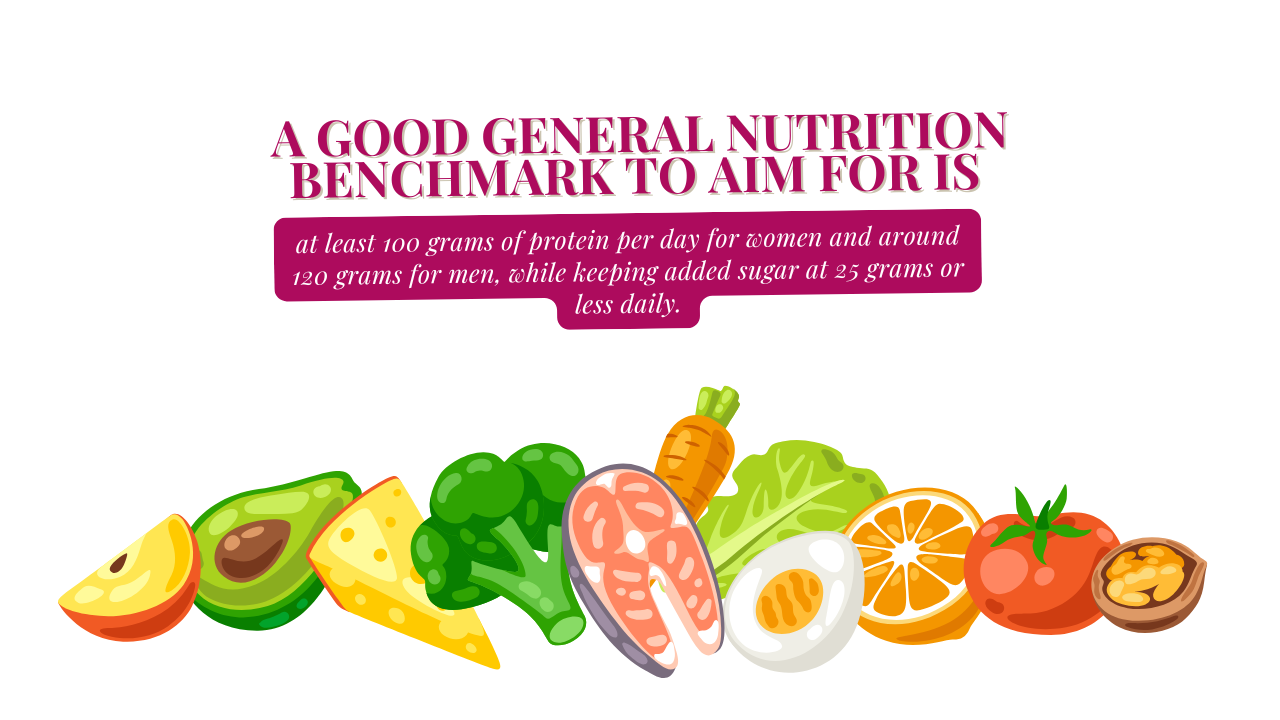
From there, the goal is to pick one thing to focus on rather than trying to make all the numbers add up at once. Maybe it's total calories, maybe it's protein intake, maybe it's added sugar — but zeroing in on just one area at a time keeps things manageable and sustainable. A good general benchmark to work toward is at least 100 grams of protein per day for women and around 120 for men, and ideally keeping added sugar at 25 grams or less daily. Logging doesn't have to be a permanent, all-consuming habit — even a few days of spot-checking every now and then can be incredibly useful for staying connected to what you're actually eating.
When You've Already Done the Work
Calorie counting and logging works really well — but not for everybody, and that's worth acknowledging. Some people have spent years, sometimes decades, cycling through diets and tracking apps, and at a certain point, all of that data starts to do more harm than good. Diet fatigue is real, and for a lot of people, a long history of obsessive logging has created a pretty complicated — sometimes really painful — relationship with food. If every meal has ever felt like a math test you could fail, then strapping yourself back into an app might not be the move.
There's also just the reality that logging can be, like, really rigid in a way that backfires for certain personalities. Some people find that the minute they start tracking, they either rebel against it entirely or get so caught up in hitting numbers that they lose sight of actually nourishing themselves. And others find it turns every eating experience into a source of stress rather than satisfaction — which is pretty much the opposite of what we're going for here. Food is meant to fuel you and, yes, to bring you some joy, and if logging gets in the way of that, it's simply not the right tool for you.
That said, if you've already done the work — if you can look at a plate and have a solid sense of what's on it, you know roughly where your protein lands, and you've long since cleaned up your sugar habits — you really don't need an app to validate that. An occasional spot check here and there is more than enough to make sure nothing has quietly crept back in. The goal was always awareness, and if you already have that, you've basically graduated. The app was just a means to an end, not the end itself.
Ditch the "I Blew It" Mentality
One of the most liberating things to accept about calorie tracking is that it will never be perfect — and that's completely okay. Unless you're weighing every gram of food on a kitchen scale and preparing every single meal yourself, there will always be variables. Restaurant portions vary wildly, recipes differ, and life simply doesn't cooperate with precision. Expect at least a 20% margin of error, and make peace with that upfront. The goal of logging isn't exactness — it's awareness.
What tracking does well is help you build a mental library of the foods you eat. You start to notice which meals are quietly calorie-dense and which ones fit easily into a balanced day. A simple example: at a steakhouse, a rib eye can have two to three times the calories of a filet. If you enjoy both equally, that's an easy, painless swap to make — no deprivation required, just information. Over time, those small recognitions add up and start to shape your choices naturally, even when you're not actively logging.
The most important thing to leave behind when you track is the "I blew it" mentality. Eating a milkshake or a cheeseburger or a heavier meal doesn't erase your progress — it's just one meal. Enjoy it, learn from it, and move on. The goal is an 80/20 approach: about 80% of the time, eat food that genuinely fuels your body, and the other 20% can be for joy, for celebration, for the rib eye. Perfection was never the point. Every meal is simply a new opportunity to make a choice that works for you.
If this resonated with you, make sure to check out the full episode for an even deeper dive into everything we covered — from how your metabolism actually adapts to calorie restriction, to the practical way to start logging without making it stressful, to figuring out whether tracking is even the right move for you in the first place. It's a really good one, and honestly, it might just change the way you think about food and your health for good. You can find it wherever you listen to your podcasts — don't miss it!
More from The Dr. Francavilla Show:
Subscribe to The Dr. Francavilla Show on