
Micro-Dosing GLPs Like Wegovy and Zepbound — Do We Even Need To???
What If the Lowest Dose Isn't Actually the Safest Dose?
If you've spent any time in weight loss or wellness spaces online, you've probably come across the term microdosing — and chances are, it was framed as the smarter, gentler, more mindful way to use GLP-1 medications. But is that actually true? That's exactly what we're digging into on today's episode of The Dr. Francavilla Show.
Microdosing GLP-1s was a massive topic on social media a while back, and while the buzz has quieted down a little, the mindset behind it hasn't gone anywhere. In fact, what's been showing up in clinic lately is something worth addressing directly: patients who are hesitant to increase their dose — or even reach a standard therapeutic dose — even when the evidence clearly supports it. There's this underlying belief that staying on a lower dose is somehow better, more virtuous, or safer. And that's the idea we're going to unpack today.
Here's the thing worth sitting with before we go further: there is no prize for taking the lowest dose. The goal isn't to stay as low as possible, and it isn't to push as high as possible either. The goal is to find the dose that actually works for you — for your body, your health conditions, and your specific outcomes. Keep reading to find out why that distinction matters more than you might think.
Is "Microdosing" GLP-1s Actually a Thing?
The term microdosing has been floating around wellness circles for a while now — first with psychedelics, and more recently with GLP-1 medications like semaglutide (Wegovy) or tirzepatide (Zepbound). In both cases, the appeal is the same: using a smaller amount feels safer, less intense, more manageable. It's almost homeopathic in thinking — like the dose is so small it barely counts. But when it comes to GLP-1s, it's worth asking: is microdosing a legitimate clinical approach, or is it mostly a marketing term?
Here's the honest answer — it's largely marketing. There are no high-quality studies, no clinical consensus, and no standardized definition of what a "microdose" of a GLP-1 even means. For context, the lowest commercially available dose of semaglutide is 0.25mg, and the standard therapeutic dose for weight loss is 1.7mg. Anything below that range could loosely be called a microdose, but no one has agreed on a number. That lack of standardization matters, because without it, the term can be used to describe almost anything — and often is, especially by compounding pharmacies trying to make people feel more comfortable trying these medications.
That said, dose does matter in medicine — just not always in the way we assume. A great example is naltrexone, a medication used for addiction treatment that actually has very different properties at low doses, including benefits for chronic pain. So the idea that lower doses can behave differently isn't without basis. The problem with GLP-1 microdosing specifically is that we have no evidence it offers any advantage — and it may simply be less effective. Until there's actual research behind it, "microdosing" a GLP-1 is more of a comfort concept than a clinical one.
The Right Dose Is the One That's Actually Working for You
One of the foundational principles in medicine is that the lowest effective dose is always the best dose. We don't give people more medication than they need — but the key word there is effective. With GLP-1 medications, that means the dose you're on should actually be doing the job it's meant to do. And to figure that out, you first have to ask: what exactly are we treating?
If the goal is weight loss, the answer is relatively straightforward — your results will tell you a lot. If you're losing weight steadily, your food noise has quieted down, and eating feels more balanced and effortless, that's a good sign your current dose is working. But if you're managing type 2 diabetes, the scale isn't the only thing we're watching — blood sugar levels matter too, and the dose needs to reflect that. For sleep apnea, the data points to needing higher doses, specifically the 10–15mg range for Zepbound, which is what's approved for that indication. And for cardiovascular disease prevention, the studied doses of semaglutide showed a 20% reduction in major cardiac events — we don't have that same data for lower or microdoses, so staying on a standard dose matters if that's part of your treatment picture.
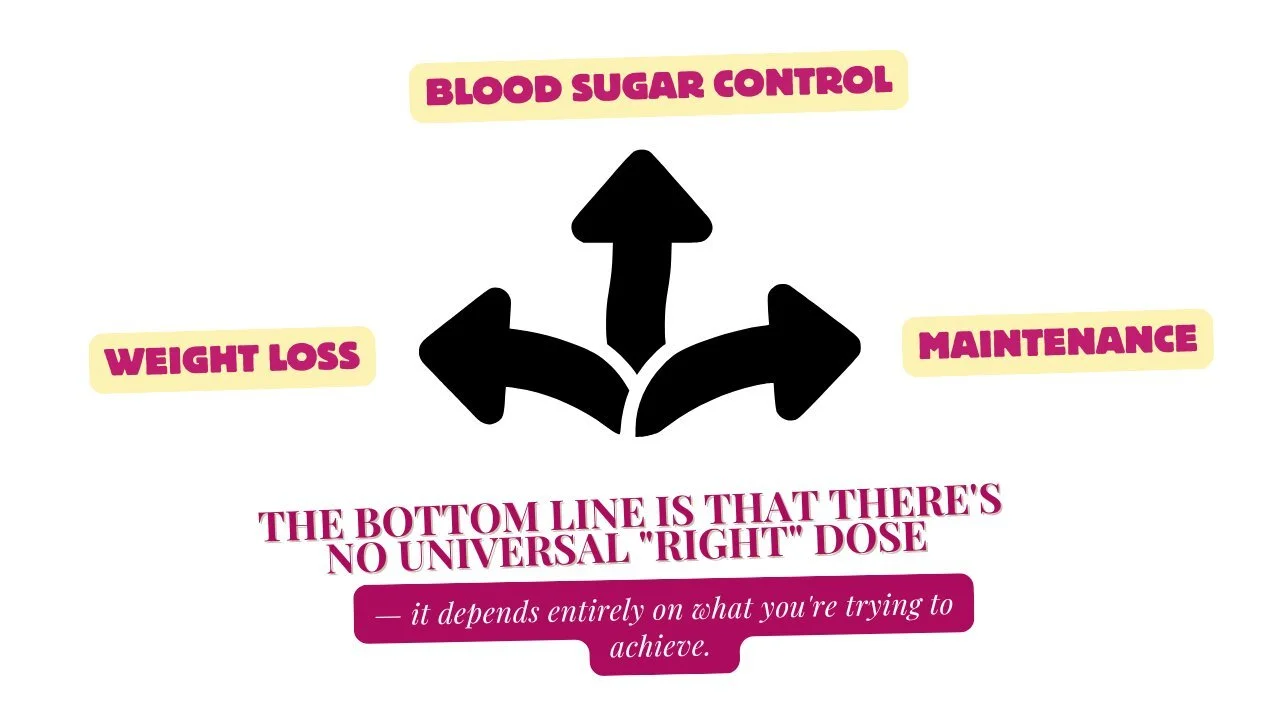
The bottom line is that there's no universal "right" dose — it depends entirely on what you're trying to achieve. There's also no need to rush the process. Titrating up slowly is completely valid, and staying on a lower dose longer to minimize side effects is a reasonable approach. But if your goals aren't being met — whether that's blood sugar control, weight maintenance, or managing a specific condition — a higher dose may simply be what your body needs. And that's not a failure. That's just good medicine.
Weight Loss Is a Side Effect, Not Always the Goal
Weight loss and health improvement are not the same thing. The number on the scale is one data point, but it's not the whole picture. Depending on why you're using a GLP-1 medication, your real goals might look like better blood sugar control, lower blood pressure, improved sleep apnea, less liver fibrosis, more energy, or simply feeling more comfortable moving through your day. For a lot of people, those outcomes matter far more than total pounds lost — and that's completely valid.
What's also worth knowing is that GLP-1s are showing up in conversations beyond traditional weight management. There's emerging data suggesting these medications may help with inflammatory conditions — things like joint pain, skin diseases, and other inflammatory markers in the body. People are reporting less overall pain, and some studies on osteoarthritis and inflammatory conditions are showing real benefit. If that's part of why you or your doctor are considering this medication, the same rule applies: define the goal, then evaluate whether the dose is actually getting you there. Are your symptoms improving? Are inflammatory markers moving in the right direction? If not, and you're tolerating the medication well, it may be worth titrating up.
That said, when we move into off-label territory, the risk-benefit conversation becomes more important. If someone already has a low BMI, additional weight loss could do more harm than good — and these medications do carry real risks. Using them for a less-established reason, like inflammation, requires a more careful, individualized conversation between patient and provider. It may absolutely be worth trying, especially if other treatments have been exhausted, but it shouldn't be taken lightly. The honest truth is we know the right doses for weight loss, diabetes, sleep apnea, and liver fibrosis — we don't yet have that same clarity for inflammatory conditions. Until we do, those decisions deserve extra care.
There Is No Prize for the Lowest Dose
Cost is one of the more practical reasons people gravitate toward microdosing GLP-1s — and that's completely understandable. These medications are expensive, and stretching a vial further by using a smaller dose can feel like a smart financial move. But here's the thing: if that lower dose isn't actually producing results, you're still spending money, investing time, and taking on risk — just without the benefit. If you're going to commit to this medication, it's worth giving it a real chance. A subtherapeutic dose that isn't moving the needle on your health goals isn't saving you anything in the long run.
There's also a psychological piece worth naming here. Because of how microdosing has been marketed, a lot of people have internalized the idea that a lower dose is inherently better — safer, more natural, less "intense." But that's not how medicine works. If you haven't lost weight in months, you're still experiencing food noise, and you have zero side effects, that's not a sign to stay where you are — that's a sign your body can handle more and likely needs it. There is no prize for taking the smallest possible dose. The goal is to find the dose that's actually working for you and your specific health outcomes, whether that's weight loss, blood sugar control, sleep apnea, or something else entirely.
A lot of the microdosing conversation is also tied to compounded GLP-1s, which initially entered the market during a legitimate drug shortage. That shortage is over, but the financial incentive to keep selling custom-dosed compounds never went away. The reality is that with the range of FDA-approved doses and formulations now available, custom compounded doses are rarely — if ever — medically necessary. The push for them is largely commercial, not clinical. At the end of the day, microdosing is a marketing term, not a medical one. The right dose is the one that gets you to your health goal, with side effects you can manage. That's it. Nothing more, nothing less.
If there's one thing to walk away with from this conversation, it's that the dose that's right for you isn't defined by what sounds the safest, what your friend is taking, or what a compounding pharmacy is marketing as the next smart approach to weight loss. It's defined by your health goals, your body's response, and what the evidence actually supports for your specific situation.
Microdosing as a concept isn't inherently wrong — the lowest effective dose really is the goal in medicine. But "effective" is the word that matters. A dose that isn't getting you to where you need to be isn't a win just because it's small. Whether you're managing your weight, blood sugar, sleep apnea, cardiovascular risk, or inflammation, the question to keep coming back to is simple: is this working? If the answer is yes, great — stay there. If the answer is no, it may be time to have an honest conversation with your provider about going up.
You deserve to get the full benefit of a medication you're already investing in. Don't let marketing language or an internalized bias toward "less is more" stand between you and real results.
More from The Dr. Francavilla Show:
Subscribe to The Dr. Francavilla Show on