
Wegovy, Zepbound and Obesity Care for Older Adults With Dr. Melanie Jay
Is it too late to lose weight at 65?
And if it isn't, how much do you actually need to lose, and which treatments are safe for an older body? With Medicare patients now able to access GLP-1 medications through the Bridge program, these questions are suddenly a lot more practical than theoretical, and there's like, a lot of confusion out there about what's right for older adults.
To help sort it out, today's guest is Dr. Melanie Jay, a professor of medicine and population health at NYU Grossman School of Medicine. She's an internal medicine physician and board-certified obesity specialist who sees patients at the New York Harbor Veterans Health Administration in Manhattan, so she's caring for older adults in real life every week. She also directs the NYU Langone Comprehensive Program on Obesity Research, and her research focuses on improving obesity treatment and prevention in primary care settings and among vulnerable patient populations.
Dr. Jay has published more than 100 peer-reviewed articles, her commentary has appeared on outlets like the New York Times, CBS News, and the Today Show, and her TEDx talk on the future of obesity care was featured as an editor's pick. She's the perfect person to walk through what older adults should know about weight, medications, and surgery,
On this week’s episode, we’ll talk about how much weight older adults actually need to lose, what to watch for with GLP-1 side effects like dehydration and muscle loss, how Medicare and the VA cover treatment, and why a strong care team can make all the difference.
Is It Too Late to Lose Weight at 65? Dr. Melanie Jay Says No
Weight management honestly matters even more as we age, since metabolic problems like high blood pressure, prediabetes, and sleep apnea get more common with every decade. The good news, according to Dr. Melanie Jay, is that it's absolutely still worthwhile to treat obesity at 65 and beyond, and the amount of weight someone needs to lose isn't one-size-fits-all. It really depends on what you're trying to treat. Sleep apnea might call for losing 10 to 15% of total body weight to see real benefits, while hypertension or prediabetes often responds to around 10%. Even a 5% loss can start improving blood pressure and lipids, so nobody has to go from the obese range to "thin" for it to count. With more powerful medications making huge weight loss numbers more common in the headlines, it's a helpful reminder that the biggest possible loss isn't the goal for everyone. The goal is matching the treatment to the health problem.
Dr. Jay describes that lifestyle is the foundation for any chronic disease, obesity included. That means eating well, meeting physical activity recommendations, sleeping enough, and taking care of mental health. For middle-aged and older adults, weight training is especially important. Lifestyle changes alone aren't the most powerful weight loss tool, but plenty of people can reach a 5 to 10% loss this way, and some lose even more. The catch is that keeping the weight off takes lifelong changes, so a person can't lose 5% and then slide back into old habits. Dr. Jay points out that some patients keep off large amounts of weight for decades, while others regain it after losing a lot, which shows how much researchers still have to learn about why outcomes differ so much.
The other two pillars are medications and bariatric surgery, and both work well in older adults. The big takeaway is that age alone shouldn't steer anyone away from these options if they truly need them. A realistic target based on your own health conditions, built on a lifestyle foundation and paired with medication or surgery when appropriate, can make a meaningful difference at any age.

Skipping Meals in Older Age
A lot of clinicians notice that patients over 65 tend to eat just one or two meals a day, often skipping breakfast. It's a totally fair thing to wonder whether there's a scientific reason behind it, and whether it's actually good for this age group.
For some people, a time-restricted approach can be genuinely helpful. Eating only between, say, 10:00 AM and 6:00 PM can make it easier to take in fewer calories across the day. The flip side is that fewer meals means each one carries more nutritional weight, so what's on the plate matters even more for nutrition and overall health. If you're only eating twice, those meals need to be the extra healthy ones, not just whatever's convenient.
The bigger concern is fluids. Some older patients cut back on drinking because of incontinence, because finding a bathroom while out and about is a hassle, or because they don't want to keep waking up at night. Restricting fluids can become a real problem for older adults, and it's especially relevant with certain obesity treatments. So it's worth looking at how someone is eating and drinking, not just how often.
GLP-1 Medications in Older Adults: Safe, Effective, and No Age Cutoff
If you're wondering whether weight loss medications are reasonable after 65, the short answer is yes. There's no age limit on GLP-1s, and the good news is: they're safe and effective in older adults. The one caveat is that clinical trials haven't really included many people in their 90s, so the data thins out at the oldest ages. Since older adults are more likely to have metabolic disease and heart disease, they're also a group that can benefit a lot from what these medications do.
"GLP-1" is kind of a catch-all term for the newer medications built around glucagon-like peptide-1 receptor agonists. The two main ones right now are semaglutide, which people know as Wegovy or Ozempic, and tirzepatide, which goes by Zepbound or Mounjaro. The brand names just depend on whether the medicine is prescribed for weight or for diabetes, but it's the same active ingredient. Our bodies make GLP-1 naturally, but it only lasts seconds in the bloodstream, so these medications are engineered to stick around much longer. They work in the brain to make us less hungry, and they strengthen the brain-gut connection so we know when we're full. They also slow the emptying of the digestive tract, which helps people feel fuller and accounts for some of the side effects.
There's also a lot still being figured out, because GLP-1 receptors are all over the body. For cardiovascular disease, some people benefit even without losing weight, possibly through lower inflammation or other changes in the heart. Tirzepatide adds a second target, a GIP agonist, which has similar effects on appetite and on metabolic and cardiovascular health. So these medications do more than shrink appetite, and that's a big part of why they can be such a good fit for older adults.
Heart Protection in Older Adults: What the SELECT Trial Showed for Wegovy
Cardiovascular disease becomes a bigger deal with every decade, since the chance of a heart attack or stroke rises as we age, and it's the most common way any of us will die. That's why preventing or delaying it is such a priority for so many older adults. Dr. Melanie Jay explains that there are really two buckets here: primary prevention, meaning stopping cardiovascular disease before it starts, and secondary prevention, meaning keeping existing disease from turning into a heart attack or stroke. For primary prevention, the metabolic benefits likely do a lot of the work, like preventing diabetes, lowering blood sugar, and weight loss itself possibly delaying the onset of heart disease.
For people who already have cardiovascular disease, the SELECT trial is the big one for Wegovy. It enrolled mostly middle-aged and older adults with existing heart disease who were already on standard treatments like statins, beta blockers, and blood pressure medicines. They were randomized to semaglutide or usual care, and the semaglutide group lost weight and also had roughly a 20% lower risk of cardiovascular events over four years, which is a pretty short window to see that kind of survival benefit. Some of those benefits seem to be weight-independent, meaning people got them even without losing much weight, though nobody has a full explanation yet. Inflammatory pathways are one possibility. A similar trial with tirzepatide is still something researchers are waiting on. There's also an important limit to know about: everyone in SELECT had excess weight or obesity, so it's unclear whether people at a normal weight, like someone who's had a heart attack and wants to prevent another, would see the same benefit.
Taken together, this makes GLP-1 medications a completely reasonable option for older adults, and lowering the chance of a heart attack or stroke is a really worthwhile reason to take a medication, whether or not someone is also hoping for weight loss or better metabolic health. Because these medicines are still fairly new and research is moving fast, recommendations can shift as new indications and findings come out, which can feel confusing but is just part of learning about a new treatment.
GLP-1s in Older Adults: Muscle, Side Effects, Hydration, and Staying the Course
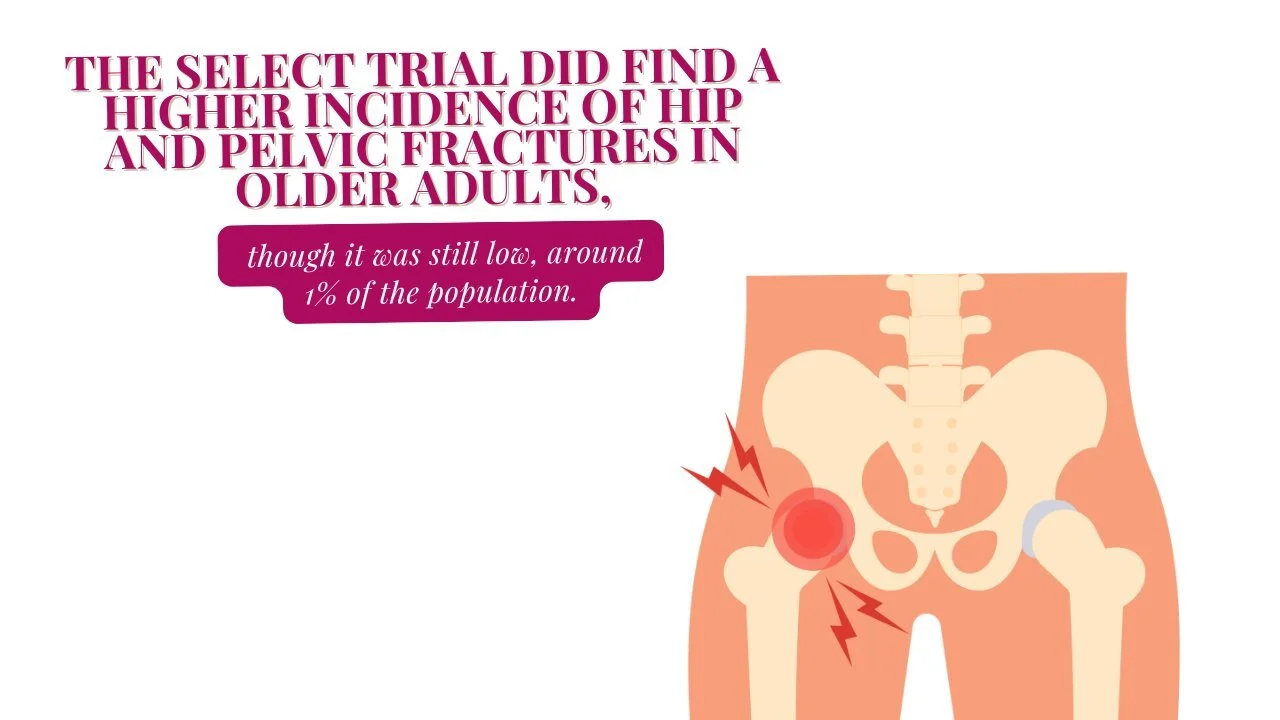
The first big consideration with GLP-1s in older adults is muscle and bone health, which is still an area with a lot of controversy and ongoing research. Dr. Melanie Jay points out that some older adults have sarcopenic obesity, meaning excess weight paired with really low muscle mass that leaves them frail. For those patients, she'd think twice about starting a GLP-1 or at least monitor them very carefully, since low muscle mass raises the risk of bone loss and fractures. The SELECT trial did find a higher incidence of hip and pelvic fractures in older adults, though it was still low, around 1% of the population. It's also worth knowing that anyone who loses a lot of weight loses some muscle, no matter the method, kind of like how carrying a 30-pound backpack builds muscle and taking it off means some of that muscle isn't needed anymore. Some studies suggest muscle mass drops while muscle function stays the same or even improves. Either way, the practical plan is to get enough protein and do some resistance training, which doesn't have to mean heavy weights. Bands or lighter weights work, walking counts as weight-bearing exercise, and all of it helps with everyday things like carrying groceries or getting on and off the toilet.
Side effects are the next thing to plan for, since about 80% of people get some kind of GI symptom. Slower stomach emptying, especially early on, can mean nausea and heartburn, particularly with greasier foods. Because a lot of older adults already deal with slow transit and constipation, the medication usually isn't started until things are moving well, and many people need extra fiber, plenty of water, and maybe a stool softener. Diarrhea is the flip side, and in older adults the worry is dehydration, which can shock the kidneys and worsen chronic kidney disease even though GLP-1s generally improve kidney function overall. Eight glasses of water a day isn't super scientific, but it's a good benchmark, with more needed in hot weather. Surgeries add another wrinkle. The medication has to be paused beforehand because slowed stomach emptying raises the risk of aspiration, and anyone off it for around three weeks needs to restart at a low dose, since jumping back to the old dose has landed people in the hospital. With so much fragmented care, it's important that every doctor knows about the medication, so surgeries or colonoscopies don't get scheduled without a plan.
The last piece is a common misconception: that you can take the medication, lose the weight, and then stop and keep it off the "natural way." Most people regain the weight after stopping, and a study showed the cardiovascular benefits faded after a year off the medication, so at this point the benefits really only last as long as you stay on it. That's why the goal is a safe, well-monitored plan, with a low starting dose, good hydration, protein, and strength work, that people can stick with long term.
Paying for Obesity Treatment After 65: Medicare, the VA, and Why Wraparound Care Matters
Cost is the big hurdle with both medications and surgery, but the picture for Medicare patients is better than it used to be. Eligible people with Medicare Part D can now get GLP-1 medication through the Medicare Bridge program for about $50 a month, compared with $500 or more per month through other channels. The program runs through the end of 2027, which is a huge boost in access for a population that often lives on a fixed income while other medical costs pile up. On the surgical side, Medicare covers gastric bypass, sleeve gastrectomy, and adjustable banding, which isn't as popular anymore. The endoscopic procedures don't appear to be covered yet. So both medications and surgery are now realistic options for Medicare patients.
Veterans have a slightly different situation. Dr. Melanie Jay works at the VA, where these medications are covered, so Medicare details aren't always top of mind for her. TRICARE doesn't cover them yet, and whether a veteran can get the medication through the VA depends on what coverage they actually have through Veterans Affairs. There's hope that will change soon, especially since the new VA/Department of Defense guidelines are quite supportive of GLP-1s as a first-line treatment for obesity, with lifestyle changes as an add-on. A lot of this is still in flux, so coverage rules are worth rechecking.
Whatever the payer, GLP-1s can be a great tool at any age, but older adults should be evaluated by a real clinician rather than clicking a link and ordering online. Some online services are literally just a form with no one ever seeing you, so nobody knows your other health conditions or lets your other doctors in on the plan. What really helps is wraparound care: a physician or other professional who's comfortable prescribing, plus dietary support from a dietitian or a good health coach. Researchers are even studying clinical pharmacists as a way to support lifestyle changes and manage the monthly dose increases when someone first starts. With a team like that and closer follow-up, the medication can be used safely.
If there's one thing to take away from this conversation, it's that obesity is a chronic disease, so whatever treatment you choose, you have to be willing to manage it for the long haul. Even after weight loss, the weight can come back, which is why metabolic health needs ongoing attention. The encouraging part is that you don't have to aim for the biggest possible number. Even a 5% loss can help, and with the Medicare Bridge program, GLP-1 medications are more within reach than they've ever been for older adults.
Dr. Melanie Jay also stresses that these medications are safe and effective at older ages, but side effects like dehydration or muscle loss can hit harder, so having the right support really matters. That means advocating for a care team that includes doctors who know the medications, plus help with nutrition and physical activity, especially that all-important strength training.
If you want to connect with Dr. Melanie Jay, the best place is LinkedIn. For more of her story and stories from her patients, including her sister, check out her TEDx talk. And to hear the full conversation, including how she got into obesity medicine and everything we covered on treatments, costs, and staying safe, head over to listen to the full episode.
More from The Dr. Francavilla Show:
Subscribe to The Dr. Francavilla Show on