
Emotional Eating: How to Recognize It and Break the Cycle with Tricia Nelson
Why Do We Eat When We’re Not Hungry?
Have you ever stood in front of the fridge for the third time in one evening, not because you were hungry, but because you were hoping something in there would make you feel better? If so, you’re far from alone. Emotional eating is one of the most common struggles around food, and it’s also one of the most misunderstood. It isn’t about willpower, and it isn’t a character flaw. Usually, there’s something deeper going on.
In this episode, we’re breaking down a conversation on emotional eating, binge eating, food noise, and how GLP-1 medications fit into the picture. Our guest is Tricia Nelson, an emotional eating expert who lost 50 pounds by identifying and healing the underlying cause of her emotional eating. Her TEDx talk has more than 3.5 million views, and she is the author of the bestselling book Heal Your Hunger: Seven Simple Steps to End Emotional Eating Now. She also hosts the podcast Confessions of a Binge Eater and has spent over 30 years researching the hidden causes of emotional eating. Her work has been featured on NBC, CBS, KTLA, Fox, and Discovery Health.
Below, we walk through what emotional eating really is, where it sits on a spectrum, how it can cross into binge eating, and a simple framework for understanding what drives the urge. We also cover practical tools you can start using today, and why changing your relationship with food matters whether or not the scale ever moves. Whether you’re curious, concerned, or just want to feel more at peace around food, there’s something here for you.
Eating to Feel Better: What Emotional Eating Really Is
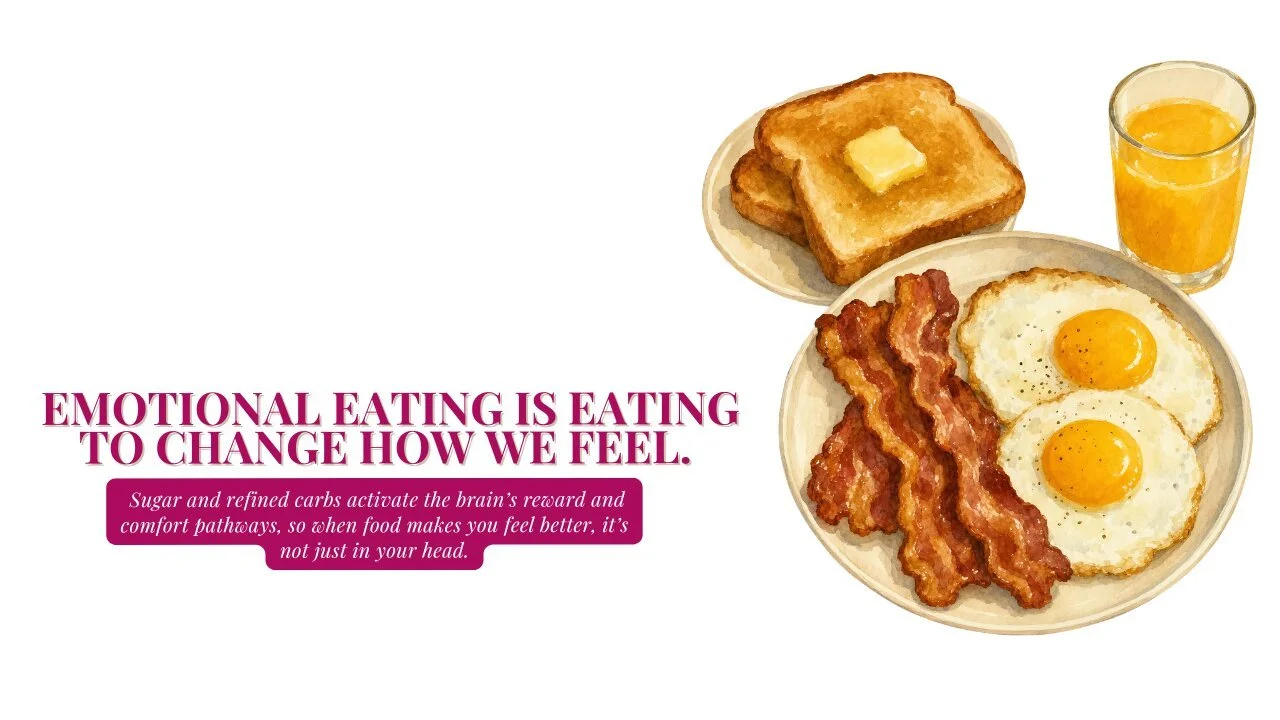
Emotional eating is simply eating to change how we feel. It isn’t just that we believe food is the only way to feel better. There’s real biology behind it. Sugar and refined carbs can give the brain a measurable boost by activating its reward and comfort pathways, so when you think, “Okay, that actually helped,” you’re not imagining it. Your brain got what it was looking for. That’s why emotional eating isn’t a sign that you’re bad or doing something wrong. It’s a coping tool that has genuinely worked for you before, and seeing it that way can take away a lot of the shame.
So what does it look like in real life? Usually it isn’t a big, conscious decision. It’s more like, “Ooh, chocolate,” or “I think there’s leftover lasagna in the fridge,” and the food just starts to seem like a really great idea. It might be grazing in front of the TV, raiding the pantry after a stressful meeting, or finishing a whole bag of something without really noticing. If you dig a little, there’s often something underneath, like a rough day, thoughts you don’t love, or just a general feeling of crummy. Most of the time we aren’t trying to feel worse, even if a sneaky subconscious part of us occasionally is.
The catch is that the relief is temporary. The mood lift fades, and the original feeling is still there waiting for you. If we go overboard, or eat something we already know doesn’t agree with us, it can backfire, leaving us physically uncomfortable, sluggish, or guilty, which is worse than where we started. The goal isn’t to never eat for comfort, because that’s not realistic, and food is allowed to be enjoyable! It’s to start noticing what we’re actually feeling before we reach for the snack, so we can choose what will truly help.
Where Do You Land on the Emotional Eating Spectrum?
Pretty much everyone has some kind of emotional relationship with food, and that’s completely normal. Eating is tied to bonding and comfort from the very start of life, like when a baby is fed by a parent, and if we had no emotional response to food at all, we might honestly forget to eat! So the real question isn’t “Do I eat emotionally?” but “How much does it take over?” A helpful way to picture this is as a spectrum. On the healthy end is run-of-the-mill emotional eating, the kind we all do from time to time, like reaching for comfort food after a long day, and it genuinely isn’t a big deal. On the far end is food addiction, where someone feels truly compelled to eat and can’t stop, even when they want to. Most of us land somewhere in between.
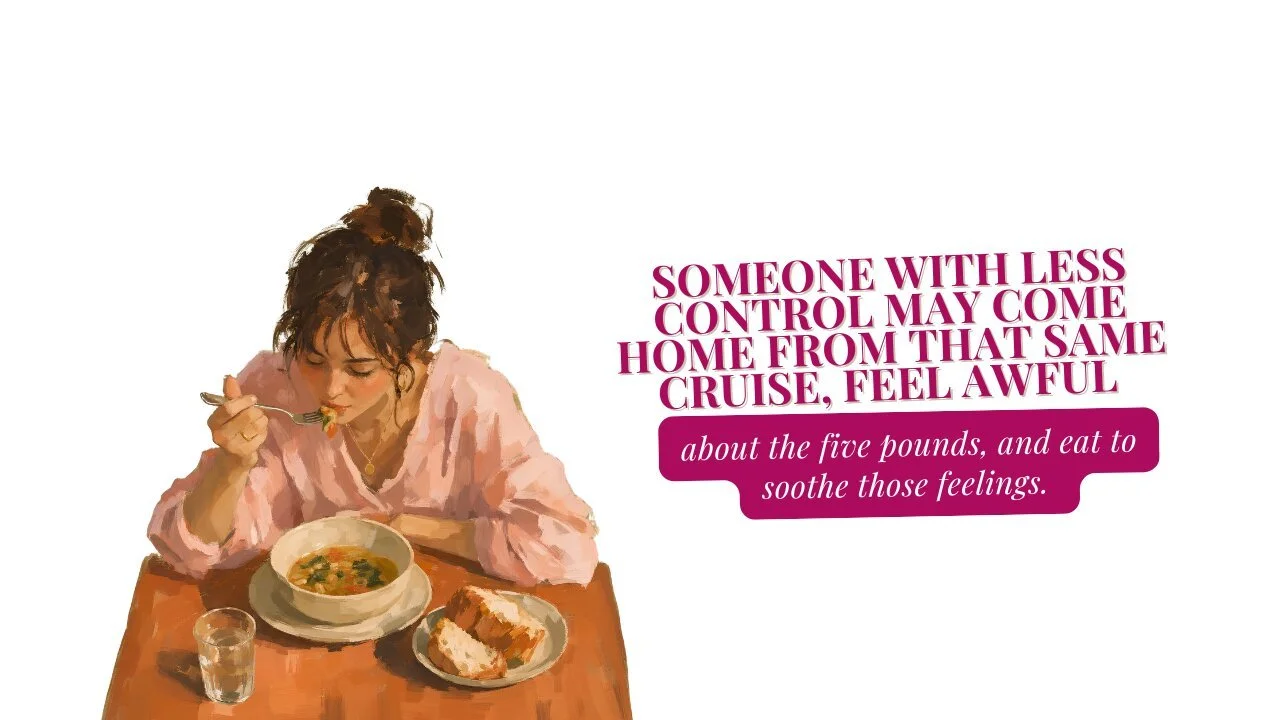
So how do you figure out where you land? It comes down to two things: control and consequences. Someone with a lot of control might have just one trigger food, like potato chips, and they manage it with simple hacks, such as not buying them or keeping them out of reach. Or picture someone who lets loose on a cruise, gains five pounds, and then course corrects by moving more and cutting back on sweets until their jeans fit again. That’s high control with low consequences, which sits comfortably in the normal range. Someone with less control may come home from that same cruise, feel awful about the five pounds, and eat to soothe those feelings. Before they know it, five pounds becomes fifteen, and it can take months to get back on track. They truly mean to change, like “Tomorrow will be different,” but the next day looks the same. That pattern of low control and growing consequences points toward the unhealthy end of the spectrum.
Here’s the part I want you to remember: the longer the cycle of “I feel bad, so I eat, so I feel worse” goes on, often paired with yo-yo dieting, the more the consequences tend to add up, both emotionally and physically. That doesn’t mean something is wrong with you. It simply means support can help. A good self-check is to ask yourself: Can I course correct when I want to? Do the aftereffects weigh heavily on me? Does food feel like it’s running the show? If you answered yes to any of these, it’s a great time to talk with a doctor, a registered dietitian, or a therapist who understands eating patterns. And if you’re somewhere in the middle, that’s okay too! Noticing where you are is the first step, and you can take it without any shame.
When Emotional Eating Crosses Into Binge Eating
Emotional eating and binge eating sit on the same spectrum, and the difference is mostly about control. With everyday emotional eating, you reach for food to feel better, and you can usually stop or course correct. It crosses into bingeing when that control slips away: what starts as “just a little” turns into a runaway train, and you keep eating even though part of you wants to stop. Sometimes the urge is partly about wanting to feel nothing at all, since being very full can numb uncomfortable feelings. But most of the time, nobody plans a binge.
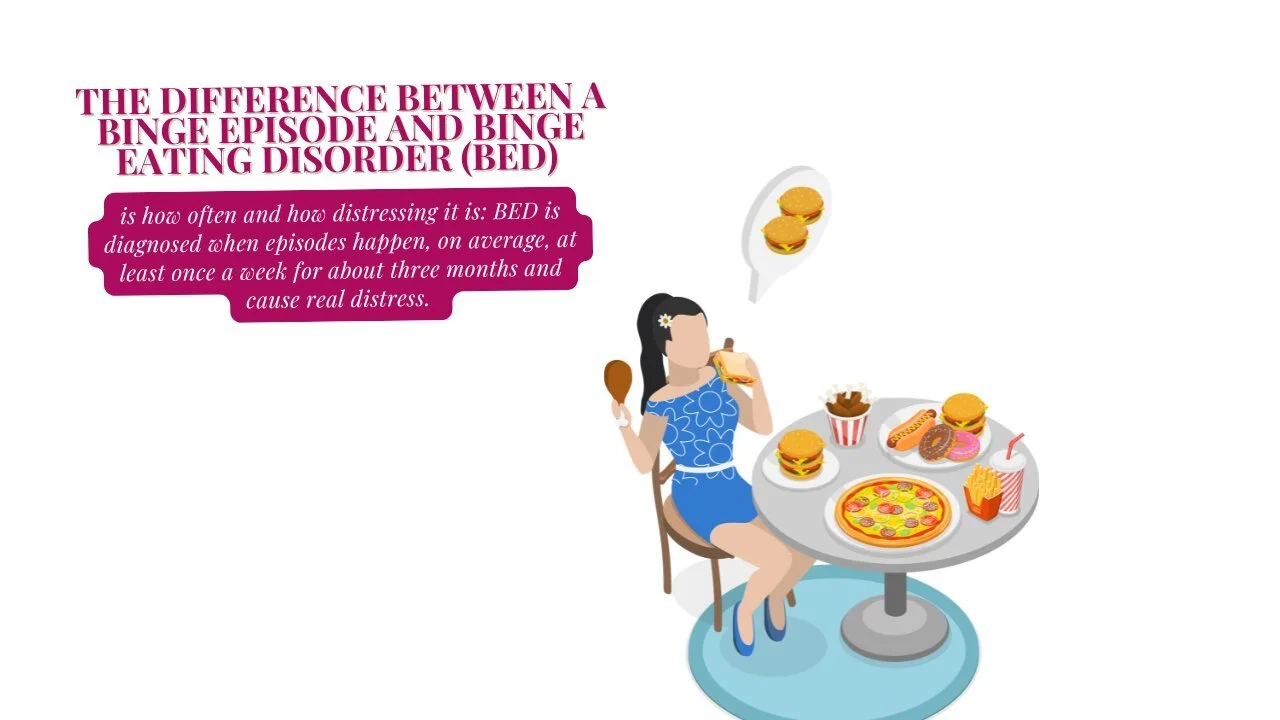
So what does a binge actually look like? Clinically, it’s an episode where someone eats a larger amount of food than most people would in a similar window of time, along with a real sense of being unable to stop or control what or how much they’re eating. Episodes often involve eating much faster than usual, eating until uncomfortably full, eating a lot when not physically hungry, eating alone out of embarrassment, and feeling disgusted, depressed, or guilty afterward. Here’s a common example: a cozy Friday evening with a little ice cream, a few cookies, and some chips because you want something salty with the sweet. You only plan on a bowl of this and a bit of that, but before you know it, you’ve eaten most of it and feel stuffed and sick. You throw out what’s left and swear you’ll never eat it again. Then, once your stomach settles, you talk yourself back into it (“they’re perfectly good cookies”), and some people end up eating from the trash, which is far more common than most realize. It usually happens in secret, often at night, followed by a heavy wave of shame and a dreaded morning-after. The difference between a binge episode and binge eating disorder (BED) is how often and how distressing it is: BED is diagnosed when episodes happen, on average, at least once a week for about three months and cause real distress. And it has no “look.” People of all shapes and sizes experience it, and many also live with constant “food noise,” an ongoing preoccupation with what to eat next.
Here’s the most important takeaway: binge eating is a recognized, treatable condition, not a personal failing or a lack of willpower. Because of the shame, a lot of people never mention it, even to doctors they trust, but bringing it up can be a game changer. A doctor, a registered dietitian, or a therapist who understands eating disorders can help you break the cycle, and approaches like cognitive behavioral therapy have strong evidence behind them. If you ever find yourself making yourself vomit or using laxatives after eating, please mention that too, since those behaviors can be physically risky and deserve care. Reaching out can feel really vulnerable, but you deserve support rather than another night of handling it alone.
Why We Reach for the Fridge: The PEP Test
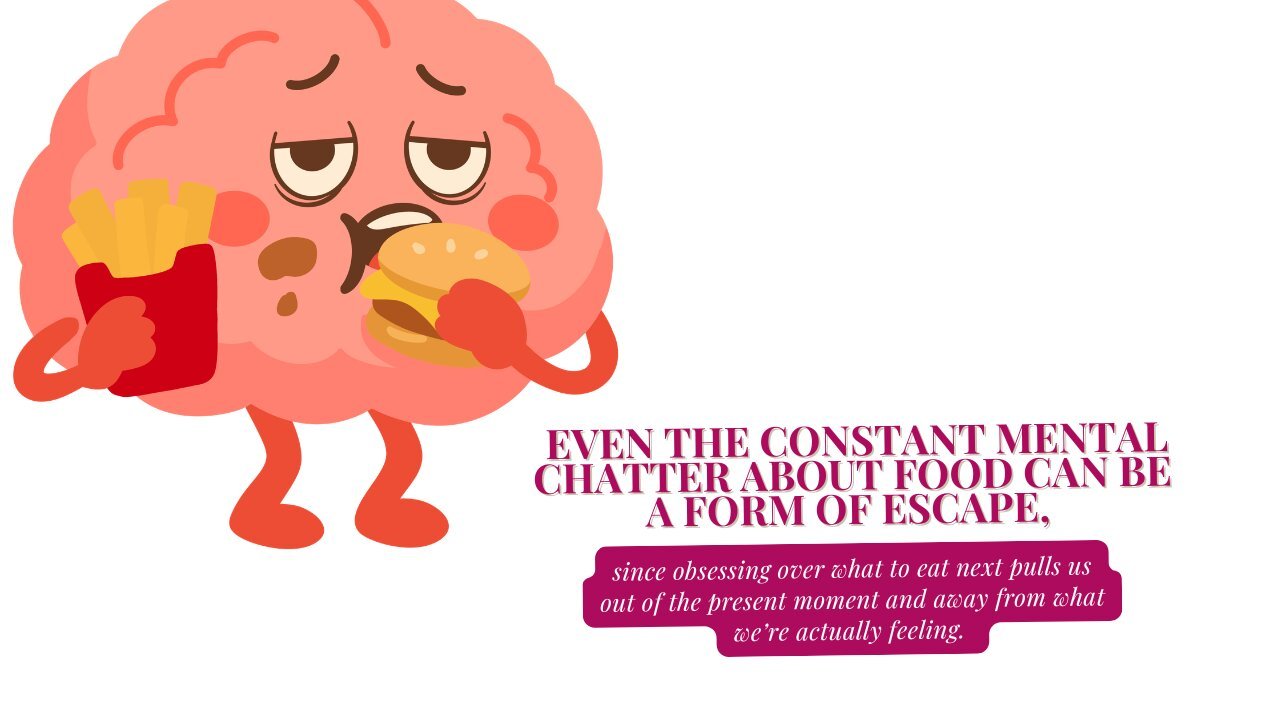
Most of the things we try for emotional eating, like cutting carbs, counting calories, or exercising more, focus on the physical side of food and weight. But for a lot of people, the urge to eat starts somewhere deeper. That’s why even GLP-1 medications, which can really quiet food noise and cravings, don’t automatically teach us how to handle stress, rejection, or upset. Some people taking them still find themselves eating emotionally, because a medication or a diet can’t hand you new coping skills. Even the constant mental chatter about food can be a form of escape, since obsessing over what to eat next pulls us out of the present moment and away from what we’re actually feeling. So the helpful question is “What am I reaching for?” and not just “What should I eat?”
One simple way to answer it is the PEP test, which sorts emotional eating into three common motivators: painkiller, escape, and punishment. Painkiller means using food to soften life’s sharp edges, like a hard family situation, loneliness, or a surprise bill. This is why we tend to binge on sugary, starchy foods rather than salad, since they give a faster mood lift. Escape means getting away from racing, self-critical thoughts (“Why did I say that?”) or from the exhausting job of taking care of everyone else. Punishment is the sneakiest one. We eat foods we know don’t feel good for us, or go way past what we planned, and then the guilt rolls in, which keeps the cycle going. Most of the time none of this is conscious, which is exactly why it helps to name it.
The practical part is that you can use PEP as a quick check-in the next time you’re heading to the fridge for the third time. Ask yourself:
Painkiller: Am I in pain, worried, or anxious about something?
Escape: Am I trying to get away from a thought, or from a to-do list that’s way too long?
Punishment: Am I being really hard on myself, or is there a tough conversation I need to circle back on or talk through with a friend?
You’re not trying to white-knuckle your way out of eating. You’re starting a kinder, more curious conversation with yourself, and that’s often where change begins. This is general education, not a diagnosis, so if these patterns feel intense or hard to untangle, it’s worth reaching out for professional support.
Building a Bigger Toolkit: What to Do Instead
Once you’ve figured out what’s driving the urge, what do you actually do? The big idea is that food can’t be your first, second, and third coping tool: you need a wider toolkit. The first step is simply interrupting the pattern in the moment: say a phrase to yourself, move your body for a few minutes, or shift a thought. Sometimes the best move is just not wandering into the kitchen at all. The point isn’t perfection. It’s creating a little pause between the feeling and the fork, so you have room to choose.
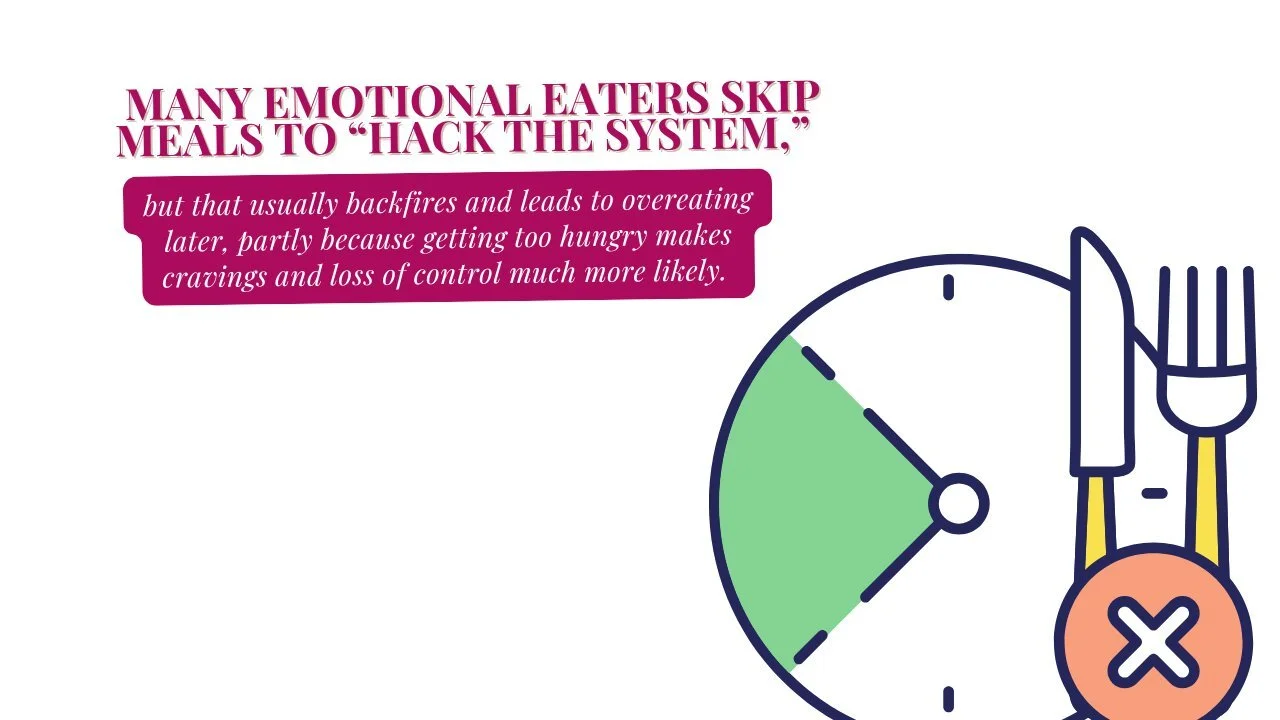
Interrupting the urge works best when it’s backed by a steady routine, and that starts with eating at regular times. Many emotional eaters skip meals to “hack the system,” but that usually backfires and leads to overeating later, partly because getting too hungry makes cravings and loss of control much more likely. Regular, planned meals help steady your hunger, give you space to notice your feelings between meals, and signal to your body that it’s going to be fed, which can calm your nervous system over time. One approach is three meals with nothing in between, though that isn’t right for everyone. Some people need snacks for medical reasons like diabetes or pregnancy, so check with your care team about what fits you. And if feeling hungry has always felt scary or unsafe, that’s worth getting support with rather than powering through alone.
The deepest layer is how you live day to day, because emotional eating is often a living problem more than an eating problem. If you’re stressed, exhausted, saying yes to everything, and hoping for a thank-you that doesn’t land the way you imagined, that’s the perfect storm for the “I deserve it” binge. So the real work happens upstream: setting boundaries, learning to say no kindly, getting good sleep, and starting your day with something that centers you, like meditation, prayer, yoga, or deep breathing, so you have resources to draw on when the stress piles up. These habits can support your overall health, but they’re mostly about feeling better in your own life.
Why Your Relationship With Food Matters
Throughout this series, we’ve talked about what emotional eating is, where bingeing fits, and how to build a bigger toolkit. Here’s the part that ties it all together: the work you do on your relationship with food pays off whether or not the scale ever changes. Struggling with food isn’t the same thing as struggling with weight. Plenty of people have a complicated relationship with eating and never think about their weight, or they’ve done a lot of work on body image and simply don’t care about the number anymore. When emotional eating or binge eating improves, whether through therapy, skills-building, or in some cases medication (like lisdexamfetamine, brand name Vyvanse, which is FDA-approved for moderate to severe binge eating disorder), weight doesn’t always change. That’s okay! Weight loss was never the only measure of success, and health can look very different at different body sizes.
So what’s the benefit, then? For one, the foods we reach for when eating emotionally are often high in added sugar, and that matters for everyone, no matter their size. Eating a lot of added sugar over time is linked with type 2 diabetes, heart disease, and dental problems, and a thin person can absolutely still be affected by their food choices. Many people also notice that sugar makes them want more sugar, and some people (even siblings in the same family!) seem wired to respond to it very differently. One person can leave a dessert half-finished, while another is already asking when they can have more. Neither is a character flaw, but if sugar tends to pull you into a cycle, being thoughtful about it is a genuinely good way to look after your long-term health.
The other big payoff is mental space. When food is constantly on your mind, whether you’re planning it, resisting it, or feeling guilty about it, it takes up a ton of room that could go to the rest of your life. Changing your relationship with food can mean less food noise, less shame, and more energy for your relationships, work, and the things you actually enjoy. It’s the “eat to live, not live to eat” idea: food is meant to be nourishing and enjoyable, but it doesn’t have to be the center of your day. If you recognize yourself in any of this, whether your weight is a concern or not, reaching out to a professional can help you find the kind of support that fits you best.
Everything we covered here, from the emotional eating spectrum to the PEP test to building a bigger toolkit, comes straight from a much richer conversation, and there’s so much more in the full episode. Tricia shares her own story in a way that’s honest, relatable, and full of hope. We’d love for you to listen to the whole thing, especially if you’re hoping to feel less alone around food.
To keep learning from Tricia, watch her TEDx talk, which has over 3.5 million views, and check out her podcast, Confessions of a Binge Eater. You can also follow her on social media for more tips, encouragement, and real talk about emotional eating. Her links are in the show notes.
You don’t have to white-knuckle your way through this alone. Press play, take what resonates, and be kind to yourself along the way. Change begins with one curious, compassionate step.
More from The Dr. Francavilla Show:
Subscribe to The Dr. Francavilla Show on