
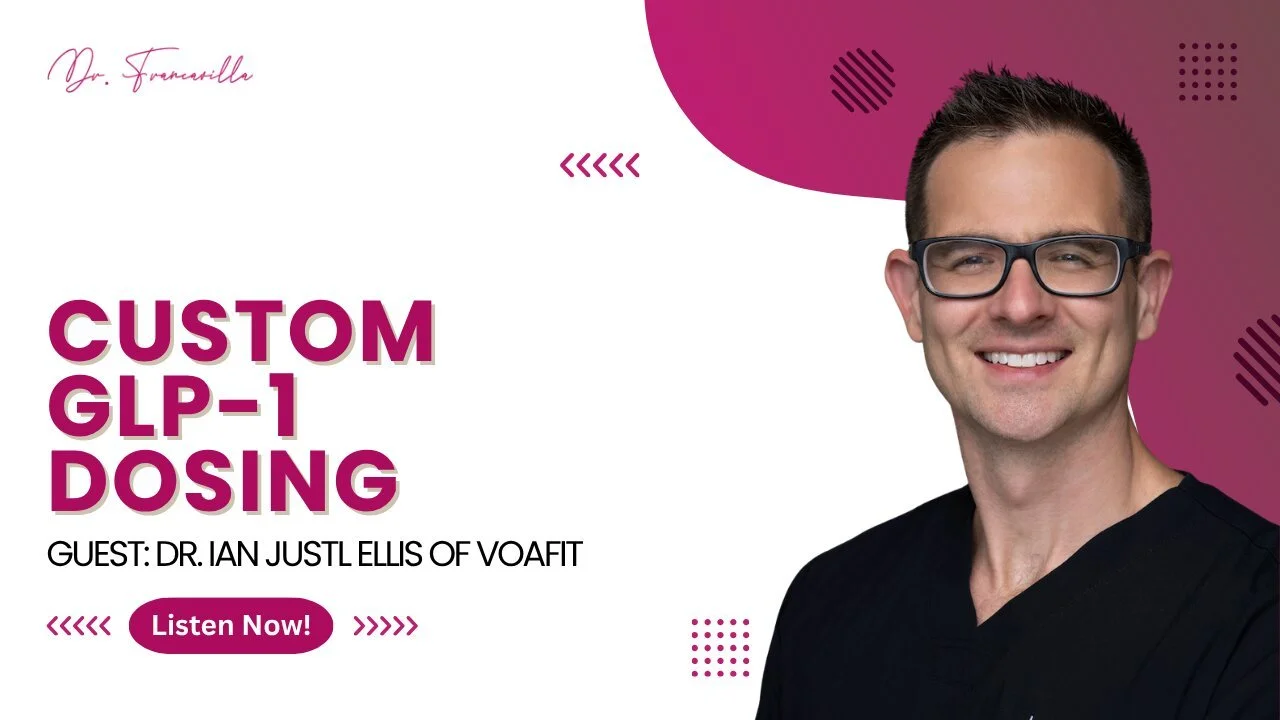
Custom GLP1 Dosing With Dr. Ian Justl Ellis of Voafit
What if the reason so many people struggle on GLP-1 medications isn't the medication itself — but the way it's being dosed?
Today we're diving into something that could genuinely change the way you think about GLP-1 therapy: custom dosing. And there is honestly no one better to talk about this with than Dr. Ian Justl Ellis.
Dr. Ian is a board-certified physician, certified personal fitness instructor, and the creator of the MyLevel GLP-1 Precision Dosing Engine. He's also the founder and CEO of VOA Fit, where he offers highly personalized concierge care through advanced GLP-1 therapy, hormone optimization, and peptide protocols — all paired with real-world fitness and nutrition strategies. Before finding his way into the obesity medicine world, he spent a decade in emergency medicine.
What makes his perspective especially interesting is how he bridges both clinical medicine and lived experience with weight management. His work focuses not just on prescribing GLP-1s, but on optimizing how they’re used in real-world patients. And that’s exactly what we’re unpacking today—how dosing strategy can completely change outcomes.
So let's get into it.
Dr. Ian's Story: How His Own Experience Changed His Approach to Weight Loss
Before medicine ever became his career, weight was already writing the first chapter of Dr. Ian's story. Growing up, he watched the adults around him cycle through dieting, regaining, and starting all over again — and he made a quiet, determined decision that he wasn't going to do the same. So he dove in. He learned everything he could about fitness and nutrition, convinced, like so many of us, that the formula was pretty simple: eat less, move more, and just... have enough willpower. For a while, it really seemed to be working. He tracked his calories meticulously, followed strict food rules, and built a body that looked healthy from the outside. But underneath all of that discipline, something wasn't right. Looking back, he can recognize those patterns for what they were — signs of an eating disorder, marked by restriction, binge eating, and using intense exercise as punishment for eating "too much."
Then life, like it always does, got in the way. Medical school, residency, long hospital shifts, marriage, a baby — the routines he had basically built his entire sense of control around started slipping. His appetite didn't go anywhere, but his ability to white-knuckle his way through it did. By the end of residency, he had gained 65 pounds, developed sleep apnea, and found himself sitting in the exact frustration he had spent his whole life trying to avoid. And here's the thing that really hit him: if someone with all the medical knowledge, all the discipline, all the resources — was still struggling this much, then maybe the problem was never about trying hard enough. Maybe the traditional advice just wasn't getting to the actual root of the issue.
That realization changed everything. Not just the way he understood his own body, but the way he showed up for his patients. He stopped seeing weight as a character test and started understanding obesity as what it actually is — a complex, chronic disease shaped by biology, hormones, environment, and genetics. Today, his work is about helping people move past shame, past blame, and past the exhausting idea that they just need to try harder. Because lasting change doesn't come from fighting your biology harder. It comes from finally understanding it — and working with it instead.

When GLP-1s Changed Everything — and What Went Wrong First
That new way of thinking opened a door he hadn't expected. It was 2021, and during a late-night ER shift, he was venting to a colleague about the donuts sitting at the nurses' station and how hard it was to just ignore them. She mentioned a drug she'd heard about — Ozempic. Something about how it just... quieted the noise around food. For someone who had spent literal decades at war with his own hunger, his reaction was basically immediate: where do I sign up?
He started on a low dose of semaglutide, and the very next day, something shifted. He still got hungry — but when he ate, he got full, and then he just... stopped. Put the food away. Walked out of the kitchen without negotiating with himself, which, for him, was kind of a big deal. He describes watching his young daughter eat half a popsicle and run outside to play — totally unbothered, completely done — and having this moment of realizing: oh. This is how it's supposed to feel.
But the story doesn't stay that clean, because of course it doesn't. The following week, he took his next dose and didn't feel quite right. The week after that, worse. Then came the nausea, the GI disruption, and those infamous sulfur burps that nobody had warned him about. He followed the standard escalation schedule — and got seriously sick. Never really felt good again for the rest of that course. He finished it anyway, lost the weight, and then got a body composition scan that stopped him cold. Despite meaningful movement on the scale, his body fat percentage was basically unchanged. He'd lost lean muscle mass alongside fat — ending up smaller, but not actually healthier. Not stronger. The number moved. The composition didn't.
That scan became the catalyst for everything that came next.
The Missing Key: Why Levels Matter More Than Doses
Dr. Ian had spent years fighting his own biology, found a framework that finally made sense, and then discovered a medication that felt like the missing piece — only to realize the way it was being used was getting in its own way. That body composition scan wasn't just disappointing, it was clarifying. That very first week on semaglutide had shown him exactly what was possible. The question that wouldn't leave him alone was simple: why couldn't every week feel like that?
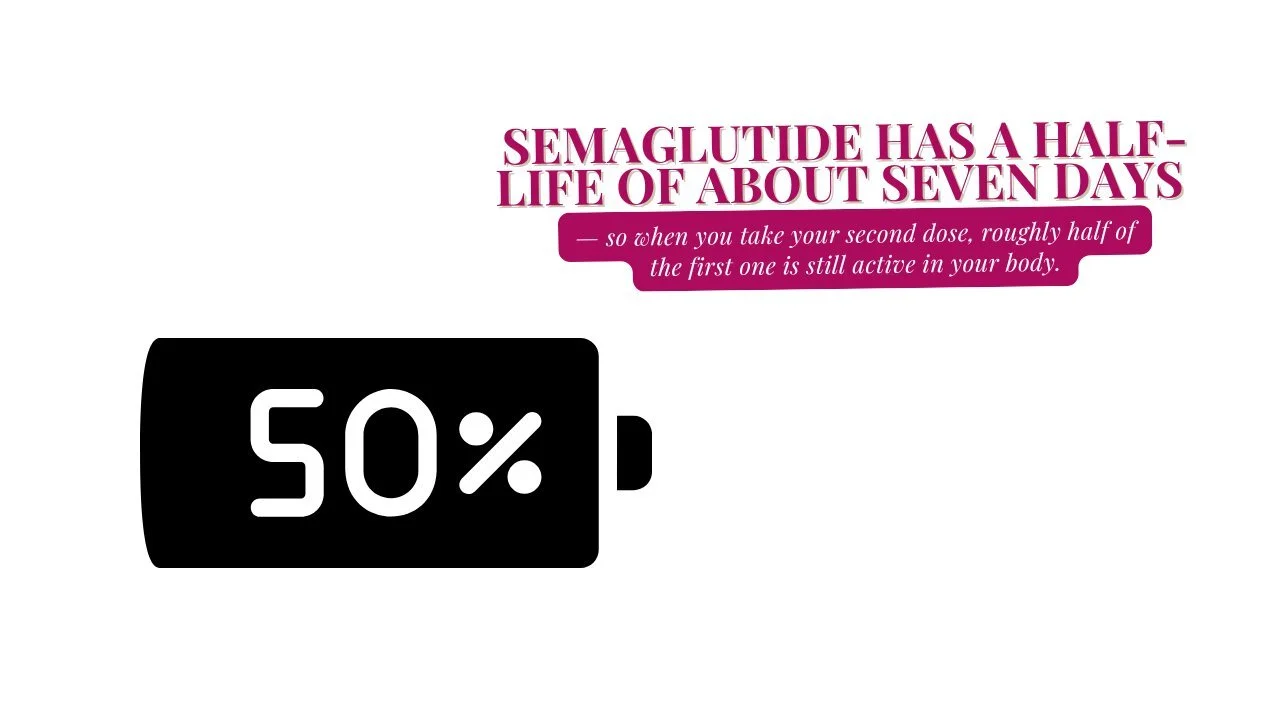
Turns out, the answer was hiding in basic pharmacokinetics. Semaglutide has a half-life of about seven days — so when you take your second dose, roughly half of the first one is still active in your body. Your drug level just climbed 50% without any change in dose. By week three, it's even higher. And right around the four to five week mark, when levels are finally starting to stabilize? The standard protocol says it's time to increase the dose — which kicks the whole accumulation cycle off again. Most people never actually find a steady state. They just keep climbing until the side effects win, and wherever they land when they can't push further — that becomes their dose. Not because it's right for them. Just because it's the most they could handle.
So he did things differently. He spent a year calculating individualized doses by hand for his patients, and the results were hard to ignore — faster weight loss than clinical trials, almost no one dropping out from side effects, and patients doing well at roughly a quarter to half the standard doses. Eventually he built an app to make that process scalable. It tracks each dose, calculates real-time drug levels, and figures out the exact amount needed to keep each person at their personal sweet spot. Plateaus get addressed with a 2% nudge in drug level — not a dramatic dose jump that brings all the misery back with it.
The whole philosophy comes down to one shift in thinking: it's not about the dose, it's about the level. And that level is going to look different for everyone. Some people respond at very low amounts. Others genuinely need more. What matters is whether the medication is actually working for that person — whether they feel okay, whether appetite is manageable, whether things are moving in the right direction. That's what cookie-cutter protocols miss. Dr. Ian spent years fighting his own biology before he figured out how to work with it instead — and now that's exactly what he's helping his patients do too.
Personalized Dosing in Practice
The theory is compelling. But what does it actually look like in practice?
Take a patient who had just started tirzepatide — someone who flagged upfront that she tends to be sensitive to medications. Rather than starting at the conventional beginning dose, her starting level was set at roughly one-tenth of that. A MyLevel score of 1 out of 50, where 50 represents the maximum studied dose and each step is just a 2% increase in drug level. Pretty conservative, right?
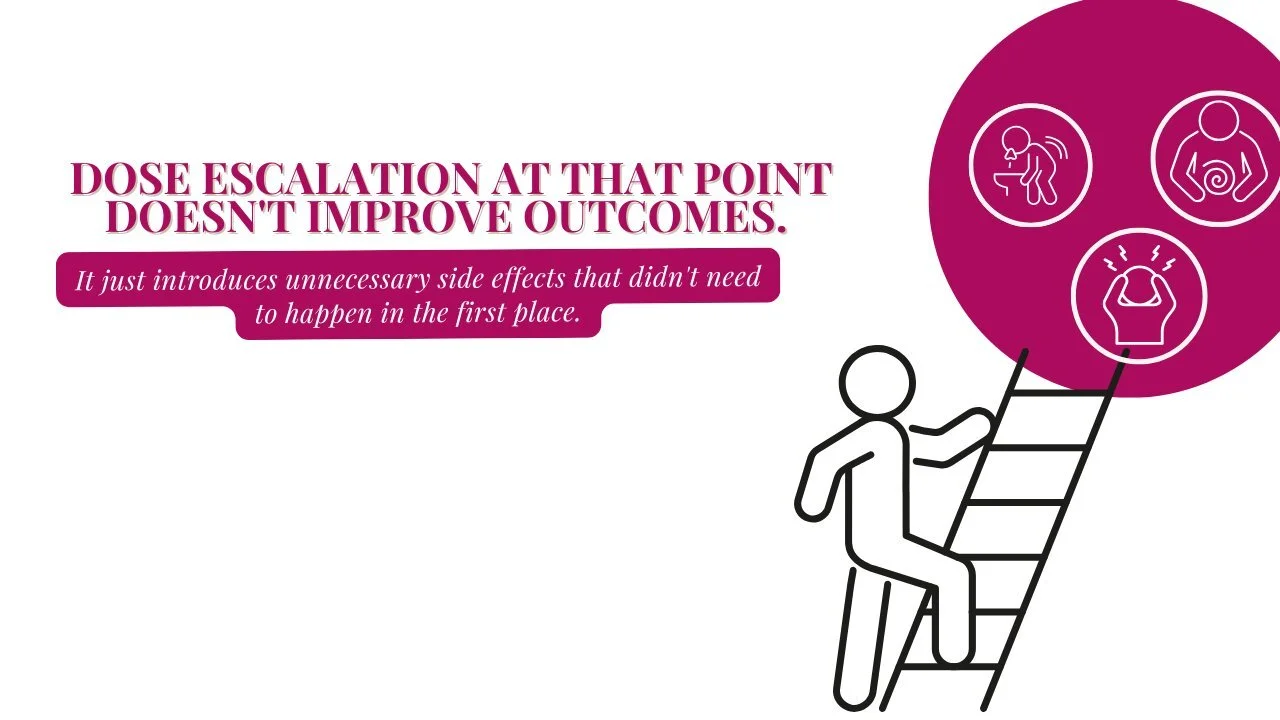
One week later, her report: appetite controlled, food noise gone, two pounds lost, feeling great. And here's where it gets interesting — the instinct in conventional medicine would be to see that as a green light to push higher. But it's actually the opposite. When someone has found the level where the medication is doing exactly what it's supposed to do — quietly, comfortably, effectively — the right move is to just... stay there. Dose escalation at that point doesn't improve outcomes. It just introduces unnecessary side effects that didn't need to happen in the first place.
So instead of bumping to a higher dose on a fixed schedule, the next dose was calculated precisely to hit that same therapeutic level again — dosed in five days rather than seven, based on her individual pharmacokinetics. If she eventually notices the effect softening, that food noise creeping back, the response is a 2% nudge upward. One step. Just enough to restore that sweet spot without overshooting it.
This is what personalized medicine could look like. Not a one-size-fits-all protocol tweaked slightly for body weight, but a genuinely responsive approach where each patient's experience drives every clinical decision. Some people find their sweet spot at really low levels and stay there for months. Others need gradual adjustments over time. The medication, the dose, the timing — all of it follows the patient, not the other way around. The goal is straightforward: the lowest effective level that keeps someone feeling well and making progress, with room to adjust as their body changes. No unnecessary side effects, no overshooting, just the right amount at the right time for that specific person. Is this the future of GLP-1 prescribing?
What's Next — and Why It Works
For anyone wondering whether this approach is accessible right now, the honest answer is: it's getting there.
The app is currently available through direct consultation with the clinic. Patients go through an intake process, and those who are good candidates are onboarded, trained on how to use the tool, and kept under active physician supervision throughout. It's a collaborative process — the clinical team sees every dose logged, monitors drug levels in real time, and receives regular check-ins on how each patient is feeling. Nothing is happening in isolation.
A broader, more autonomous version is in development — with the goal of making it commercially available within the coming months, still under physician oversight but with more flexibility for patients to manage their own experience within defined parameters. The analogy that fits well here is a glucometer. We don't hand someone insulin and a blood sugar monitor and wish them luck. We give them the tools, the education, the framework, and then we stay involved — checking in, adjusting, fine-tuning together. That's exactly the model this is built on.
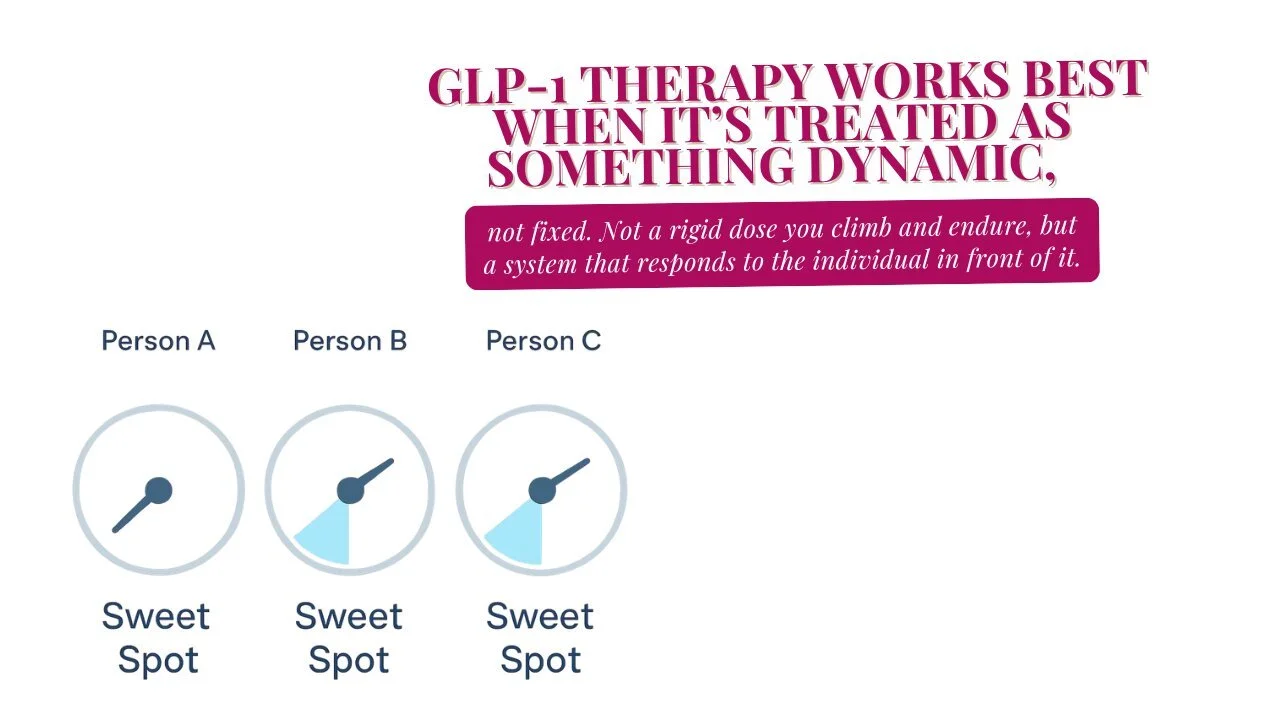
What Dr. Ian is ultimately pointing to is a pretty simple but powerful shift — that GLP-1 therapy works best when it’s treated as something dynamic, not fixed. Not a rigid dose you climb and endure, but a system that responds to the individual in front of it. And when you start thinking in terms of levels instead of standard doses, it opens up a very different way of approaching weight management altogether — one that feels a lot more personal, and a lot more sustainable.
There’s still so much nuance in how these medications are used, and honestly, we’re only just starting to understand what truly optimized care looks like in real-world settings. That’s exactly what this conversation is about — the gap between standard protocols and what actually works for people day to day.
To hear the full discussion with Dr. Ian Justl Ellis, including how this dosing approach is being applied in practice and where he thinks GLP-1 therapy is headed next, tune in to the full episode.
More from The Dr. Francavilla Show:
Subscribe to The Dr. Francavilla Show on