
JAMA Secret Shopper and What Obesity Care Should Actually Look Like
Did You Know a JAMA Study Just Exposed What's Really Happening Inside Telehealth Weight Loss Clinics?
Today, we're digging into that JAMA study that's honestly been making waves across the obesity medicine world, and once you hear the details, you'll totally get why. Researchers ran a "secret shopper" experiment, sending someone posing as a patient to 49 different telehealth clinics offering obesity management medications, just to see what kind of care they'd actually get. What they found says a lot about where the gaps are in this fast-growing corner of healthcare, and honestly, it confirms a lot of what obesity medicine providers have been quietly noticing for a while now.
In this episode, we're breaking down what comprehensive obesity care is really supposed to look like, and how you can tell whether the care you're getting, or the care you're providing, actually measures up. And by the end, we've got two calls to action for you: if you're someone taking these medications or thinking about starting them, we'll talk about how to find a provider who's doing this the right way. And if you're a clinician offering this kind of care already? Well, this is your sign to put yourself out there more, because there are patients out there who genuinely need access to someone who does this well. So keep reading, because this one's important, and you're going to want the full breakdown.
The JAMA Study Raising Questions About Obesity Telehealth
So there's this new JAMA study that came out on July 6, 2026, and honestly, it's the kind of research that's so easy to follow, you don't need a medical degree to get why it matters. Researchers ran what's basically a "secret shopper" experiment, where someone posing as a patient reached out to 49 different telehealth clinics offering obesity medications, all licensed in Connecticut, which means a lot of these were probably the big national telehealth brands you've seen advertised everywhere. What they were really testing was whether these clinics were doing a real, comprehensive obesity evaluation, or just fast-tracking people straight to a prescription. And honestly, the results kind of confirm what a lot of obesity medicine providers have been low-key saying for a while now.
The numbers are genuinely worth paying attention to. About 79.6% of clinics asked about weight loss goals, which sounds decent until you realize that means one in five never even asked. Only 65% asked about previous weight loss attempts, which is a huge deal because you can't build a personalized plan if you don't know what someone's already tried. And here's the part that's honestly a little alarming: 93.9% asked about allergies and medications, but that still leaves about 6% of clinics that skipped this totally basic safety step before prescribing something. The biggest gap, though, was around metabolic health, things like blood pressure or recent bloodwork, which only 36.7% of clinics asked about. Considering obesity so often shows up alongside conditions like diabetes, hypertension, or fatty liver disease, that's a pretty major piece of the puzzle to leave out.
This study is basically putting real data behind a concern that's been floating around in the field: a lot of these telehealth programs are treating obesity care like a quick prescription drop-off rather than the ongoing, whole-person management it actually requires. A proper evaluation should dig into weight history, past treatments, current medications, allergies, other health conditions, and metabolic markers, because that's what makes a treatment plan safe and actually tailored to the person. Obesity is a chronic medical condition, just like any other, and it deserves care that reflects that.
The Missing Piece in Many Telehealth Weight Loss Programs
Okay, picture literally any doctor's visit you've ever had. Before anyone talks treatment, you're handed that familiar list of questions: current medications, allergies, family history, lifestyle habits, mental health, the whole rundown. It feels routine, but it's actually doing a lot of heavy lifting, because that context is what keeps care safe and personalized instead of generic. Obesity treatment deserves that same level of attention, which means going beyond a basic intake form and really understanding someone's weight journey: how it's shifted over time, what's already been tried, whether surgery was ever part of the picture, and which medications actually worked versus which ones didn't.
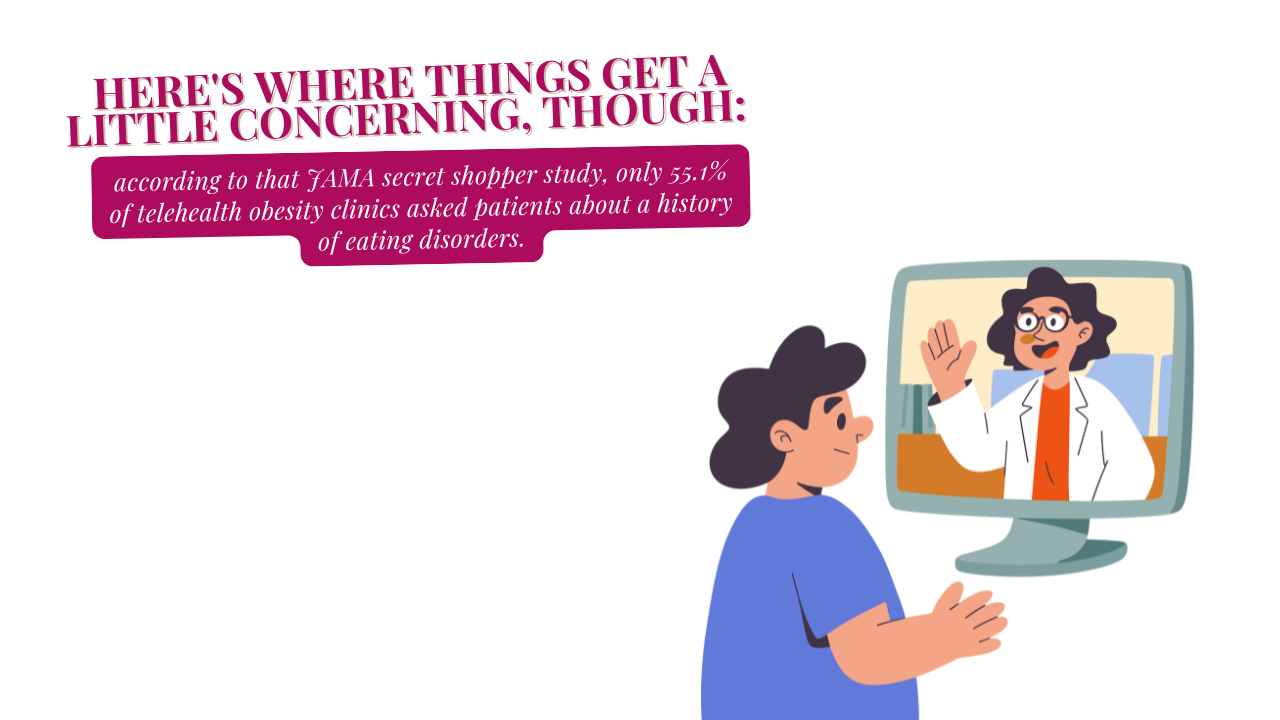
Here's where things get a little concerning, though: according to that JAMA secret shopper study, only 55.1% of telehealth obesity clinics asked patients about a history of eating disorders. And that's a pretty big miss, because conditions like binge eating disorder, bulimia, and anorexia show up alongside obesity way more often than people assume, and they can seriously change what a safe treatment plan should look like. Binge eating disorder, for instance, has its own evidence-based treatments, like behavioral therapy and sometimes medication, so if disordered eating is actually driving someone's weight struggles, that needs to be addressed directly instead of getting lumped in with a standard weight-loss protocol. Even someone with a past eating disorder can still be a good candidate for something like a GLP-1 medication, but they'll likely need extra layers of support, like counseling or closer follow-up, to make sure the process stays healthy.
The part that's honestly the most alarming is that some patients with active restrictive eating disorders are reportedly getting prescribed GLP-1s through these online programs with basically no screening at all. For someone dealing with anorexia or severe caloric restriction, that's not a small oversight, it's a genuinely risky one. Skipping eating disorder screening isn't just a missed checkbox on a form, it's a signal that a program might be moving straight to prescribing without doing the real work of evaluating the whole patient. And real obesity care should never be that transactional. It should be thoughtful, individualized, and focused on the person, not just the number on a scale.
Convenience Shouldn't Replace Comprehensive Medical Care
Another thing that stood out in the JAMA secret shopper study was just how little face time patients actually got with the clinicians prescribing their meds. Only 26% of telehealth programs required a video visit, and a mere 6% required even a phone call, meaning most people could get a prescription without ever talking to the person responsible for their care. And look, asynchronous telehealth, where you fill out questionnaires and skip the live appointment, can absolutely work when it's done well. But for something as layered as obesity management, that's probably not the gold standard. There's real value in actually speaking with your clinician: knowing who's prescribing your medication, being able to ask questions, and having someone accountable if side effects or concerns pop up later.
The study also pointed out how little verification was happening around basic patient info. Only 22.4% of clinics asked for a full-body photo, and just 4.1% wanted a photo of the patient on a scale, so the vast majority were working off self-reported height and weight alone. That sounds fine on paper, but it's honestly less reliable than people assume. Plenty of patients don't actually know their real height, sometimes off by several inches, and others haven't stepped on a scale in ages, especially if that's become an emotionally loaded thing for them. None of that is anyone's fault, but it does show why leaning entirely on self-reported numbers gets a little risky when medication is on the line.
And this is really the crux of it: without verifying weight or doing a deeper evaluation, there's not much stopping these meds from going to people who maybe shouldn't be taking them, like someone dealing with disordered eating or body image struggles where the risks could outweigh the benefits. Confirming the diagnosis first isn't just a formality, it's what makes sure treatment is actually appropriate and not just handed out based on an online form. Telehealth's convenience is genuinely great, but it shouldn't come at the cost of a careful, individualized medical assessment. That balance is everything here.
The Importance of Clinical Oversight in Telehealth Prescribing
Here's the next finding from the JAMA secret shopper study, and it's a genuinely wild one: researchers found that three different clinicians prescribed medication to the same patient across two or more separate telehealth websites. Like, the same person, getting prescriptions from the same provider, just through different platforms. That's a real red flag when it comes to oversight, because whether that happened due to heavy automation or just clinicians reviewing way too many cases too quickly, the end result is the same, a patient walking away with the potential for duplicate therapies and way more medication exposure than they should have. And that's not a small safety issue, that's the kind of thing that should be caught before a prescription ever goes out.
But here's the important nuance: this doesn't mean telehealth obesity care is broken across the board. Some programs in the study were actually hitting a lot of the recommended standards, which is honestly encouraging. Telehealth isn't the villain here, when it's done right, it genuinely expands access, makes care more convenient, and can lead to really solid outcomes. Even asynchronous care, where everything happens through messaging or questionnaires instead of a live visit, can work great, especially for existing patients whose history is already well established and understood by their provider.
It all comes back to one simple idea: convenience should never come before good medicine. Whether someone's being seen in person, over video, on a call, or asynchronously, the standard should stay the same, thoughtful evaluation, real patient safety, and a clinician who's actually accountable for what they're prescribing. Telehealth has so much potential to do good, but only when it's held to the same bar of care people expect anywhere else.
What Comprehensive Obesity Care Should Look Like
So after talking about all the gaps, it feels right to flip the script and talk about what good obesity care actually looks like when it's done properly. It starts the same way any chronic condition should be treated, with a real, thorough medical history that looks at the whole person, not just a number on a scale. That means digging into someone's weight history: when did it start, was it something present since childhood, or did it show up later in life? Those details actually matter a ton, because early-onset weight gain can point toward a genetic component, which can totally shift what treatment approach makes the most sense.
A solid evaluation also means checking for medical conditions or medications that could be quietly contributing to weight gain, things like hypothyroidism, Cushing's syndrome, or even certain prescriptions that make weight management harder. Menopause, ADHD, depression, and sleep issues can all play into it too, and none of that gets caught without a careful history and, when it's called for, some bloodwork. The whole point isn't just to hand someone a prescription, it's to actually understand why they're struggling in the first place. From there, treatment should be genuinely individualized, meaning patients get to hear about all their evidence-based options, whether that's nutrition counseling, structured lifestyle programs, specific medications, combination therapy, or even bariatric surgery for the right candidate, and then choose what fits their life and goals with their provider's guidance.
The bottom line is that real personalization means offering the full menu, not just pushing whatever medication a clinic happens to sell. And comprehensive care goes beyond weight itself too, screening for eating disorders should just be a standard part of every single evaluation, so providers can offer the right support if something comes up and help patients pursue weight management in a way that's actually safe for their body and mind. Good obesity care was never about how fast someone can get a prescription. It's about thoughtful evaluation, real individualization, and treating the whole person, not just chasing a number.
Where to Start If You're Considering Weight-Loss Medication
If you're actually thinking about starting a weight-loss medication, or you're reading all this and realizing your own care never included this kind of thorough evaluation, the best first move is honestly just booking a visit with your primary care provider. Your PCP can look at your full health picture, run the necessary bloodwork, and help figure out whether weight-loss medication genuinely makes sense for you. They're also in a great position to catch underlying stuff, like thyroid issues or other conditions, that might be contributing to weight gain in the first place, so it doesn't get missed or treated as separate from your weight journey.
Something people don't always realize is that prescribing obesity medication is completely within a primary care provider's scope, so there's a good chance they can manage your treatment directly instead of needing an outside referral right away. A lot of PCPs will actually schedule a dedicated appointment just for weight management, which might feel like it's taking a little extra time, but that's honestly a good sign, it means you're getting a real, complete evaluation instead of a rushed checkbox visit. And if your PCP isn't someone who specializes in obesity medicine, they can usually point you toward someone who does.
Here's what matters most: you deserve care that's thoughtful and evidence-based, full stop. Whether that ends up being through your primary care provider, an obesity medicine specialist, or a telehealth program that's actually doing things right, it should always start with a real look at your overall health, not just a quick glance at your weight. That's what good care is supposed to feel like.
How to Find High-Quality Obesity Care
If you're on the hunt for a provider who actually specializes in obesity medicine, there are a couple of really solid places to look. The American Board of Obesity Medicine, or ABOM, keeps a directory of physicians who've gone through advanced training and passed a certification specifically in this field, so you know they've put in extra work to really understand how obesity works and how to treat it well. There's also the Obesity Medicine Association, or OMA, whose directory includes not just physicians but nurse practitioners, physician assistants, and other clinicians who've chosen to specialize in evidence-based obesity care. Both are genuinely great starting points if you want someone who knows this space deeply.
Now, if telehealth ends up being the route that works best for you, that's totally valid, it's expanded access to care for so many people and can absolutely deliver safe, effective treatment when it's built right. The trick is just making sure it holds up to the same standard you'd expect walking into an actual doctor's office. A quality telehealth visit should include a real, comprehensive evaluation, a chance to actually talk to the clinician prescribing your medication, and a genuine conversation about your options, not just a form you fill out and forget. You should know exactly who's overseeing your care and feel completely comfortable asking questions along the way.
Honestly, it's worth pausing and asking yourself how the whole process felt. Did it feel like a real medical visit where your history was actually reviewed, or did it feel more like customizing an order online? Because there's a real difference between those two things, weight-loss medication is a serious medical treatment that needs careful evaluation and ongoing monitoring, not a quick checkout process. At the end of the day, quality care is about finding a provider who really knows your history, walks you through your options, and builds a plan around you specifically. Whether that's in person or through telehealth, your health should always come first, not convenience, not sales.
So that's the full picture, and honestly, it's a lot to sit with. This JAMA study didn't just confirm a hunch that a lot of obesity medicine providers already had, it put real numbers behind it, and that matters because it gives patients and providers alike something concrete to point to when talking about what quality care should actually look like. If you're currently on one of these medications, or thinking about starting, take a second look at how your evaluation actually went. And if you're a provider doing this work the right way, the world genuinely needs to hear from you more, because patients are out there searching for exactly that. Make sure to check out the full episode for all the details we covered today, and we'll catch you next time on the Dr. Francavilla Show.
More from The Dr. Francavilla Show:
Subscribe to The Dr. Francavilla Show on